
We independently score every service with our Experience Index. We may earn a commission if you subscribe through links on this page — it never affects our scores or picks.
"Privacy" is not a product — it's a stack. No single subscription protects your connection, your passwords, your files, and your email at once, so the honest question isn't "which one app do I buy" but "which handful of tools do I assemble, and can I get them without four separate bills?" This guide is the umbrella. It names the best pick and an honest runner-up in each category, shows how the pieces fit, and points to the one-decision shortcut for people who don't want to manage four vendors. Proton is the through-line here and the provider we have an affiliate relationship with; NordVPN and NordPass are also paying partners, and everything else — Proton Mail's rivals, iCloud, Google One, Bitwarden, 1Password — is named on merit.
How to think about a privacy stack
Before the picks, one framing decision: best-of-breed or one-vendor bundle.
Best-of-breed means choosing the strongest tool in each category regardless of who makes it — Proton VPN here, maybe NordPass there, iCloud for storage because you're on Apple. You get the best of each, at the cost of four logins, four bills, and four renewal dates to track.
One-vendor bundle means picking a single provider that covers most of the stack — in practice, Proton, because it's the only privacy-first company with a mature VPN, password manager, cloud, and email under one roof. You trade a little per-category perfection for one account, one bill, and a lower total price.
Neither is wrong. If you only need one or two tools, buy them standalone and skip the bundle. If you want three or four, the bundle almost always wins on both price and hassle. We'll flag the standalone-vs-bundle math again at the end.
VPN: Proton VPN (privacy) vs NordVPN (streaming)
The VPN is the front door of the stack — it hides your connection from your network and your internet provider. Two picks split cleanly by what you value.
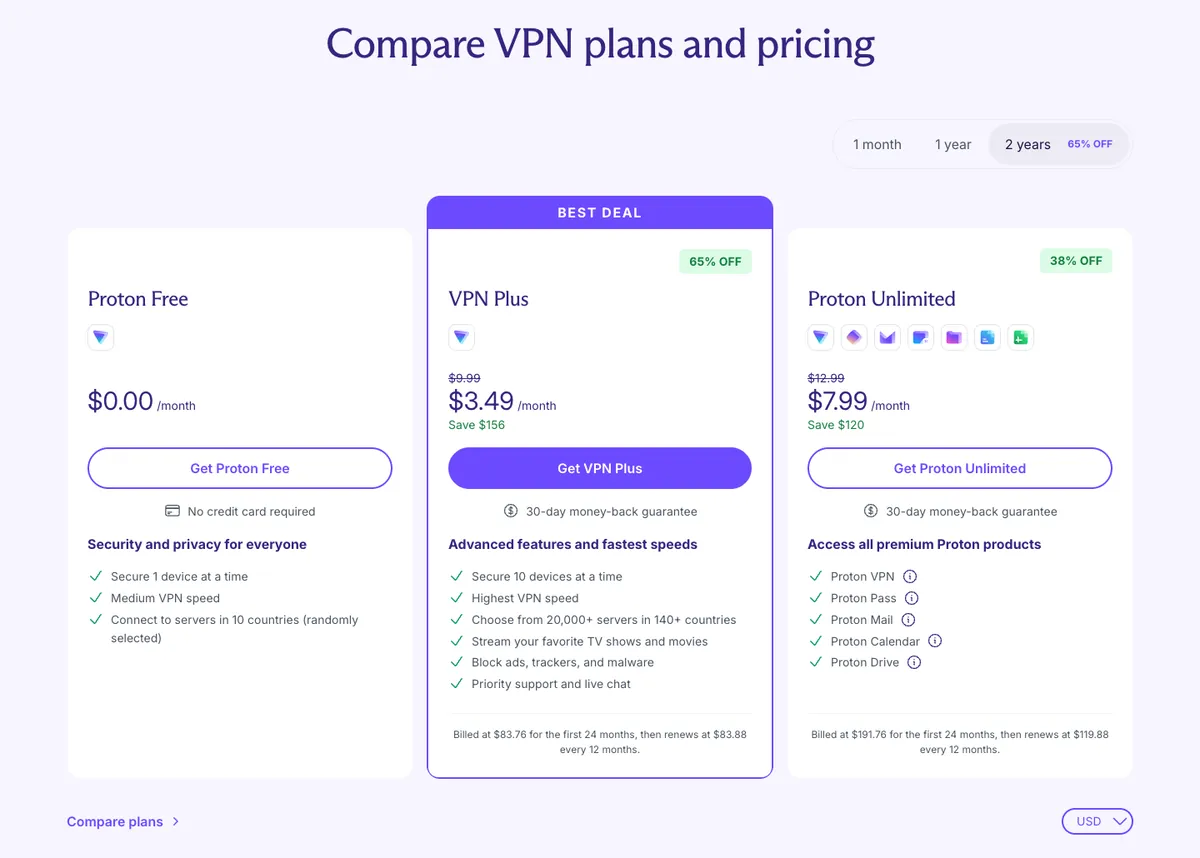
Proton VPN is the privacy pick. It's run by the Swiss team behind Proton Mail, its apps are open-source, and it's been through independent third-party audits, so the privacy claims are inspectable rather than asserted. Switzerland sits outside the major surveillance alliances with strong privacy law behind it. It's also the only mainstream VPN with a genuinely usable free tier — no data cap, one device, servers in about 10 countries — funded by paid subscriptions rather than by selling your traffic. Paid Plus adds 10 devices, Secure Core multi-hop routing, and NetShield ad/tracker/malware blocking. Its pricing has the flattest renewal curve among mainstream VPNs, though it isn't flat: $9.99/mo month-to-month, $4.49/mo on a 1-year term, or $3.49/mo on a 2-year term, with the 1- and 2-year rates both renewing to roughly $6.99/mo — the gentlest rise in the category (see which VPNs have the worst renewal pricing; US pricing verified on protonvpn.com 2026-08-20 — confirm before subscribing).
Proton VPN — Experience Index
7.1 / 10 composite
Updated Aug 21, 2026
| Dimension | Score | Consensus | Basis |
|---|---|---|---|
| Exit Ease | Moderate consensus | Official cancel page disables auto-renew immediately (clear, multi-platform) but refunds are prorated/unused-portion only and gated behind a manual support ticket; experts call cancellation frictionless yet refund proactive/manual; Trustpilot ~2.1-2.2/5 with recurring refund-denial/billing complaints. | |
| Price Stability | Moderate consensus | Tracked 2-year VPN Plus monthly-equivalent stepped up once across the tracked window, rising 16.7% to $3.49/mo as observed 2026-08-20; the same capture shows the 1-year term at $4.49/mo and month-to-month at $9.99/mo. Proton still discloses renewal inline on its own pricing page ("renews at $83.88 every 12 months" for Plus) alongside a 30-day money-back guarantee, so the structural issue remains the intro-to-renewal step rather than mid-term hikes on existing subscribers. Experts praise the upfront renewal disclosure while flagging the intro-vs-renewal gap and long-term plans above competitors; community (Trustpilot/YouTube) reports auto-renewal surprise charges and refund friction. | |
| Account Sharing | Moderate consensus | Official Proton pages and support docs confirm 10 simultaneous devices on paid plans (1 on free) and a Family plan of up to 6 separate accounts, each with 10 VPN connections, with no published anti-sharing enforcement; allowlisted reviews (Tom's Guide, TechRadar) corroborate the 10-device limit as generous but below unlimited-connection rivals; community signal (Trustpilot plus a 66-vote feature request) is thin and mixed, wanting lightweight in-account multi-user sharing. | |
| Multi-Device | Moderate consensus | Official docs confirm 10 simultaneous devices (1 on Free) plus unlimited router devices and very broad native-app coverage; allowlisted experts (Tom's Guide Apr 2026, TechRadar 2025, PCMag) confirm 10 connections and consistent, near-feature-parity apps across Windows/Mac/Linux/iOS/Android/TV; community (Trustpilot ~4.5, app stores 4.6-4.7) is positive on cross-device app experience with minor gripes about the 10-cap and support. | |
| Customer Support | High consensus | Official pages confirm 24/7 paid-only live chat, a deep Help Center, email and Zendesk ticketing, and no consumer phone; TechRadar (email <12h, chat ~9am-midnight CET) and Tom's Guide (extensive but technical docs, website-only/paid-only chat, slow-response complaints) corroborate; Trustpilot ~4.5/5 with recurring mixed support sentiment (helpful but slow). |
NordVPN is the streaming-and-speed pick. Proton actually runs more total servers, but NordVPN spreads its fleet across more distinct city locations and rotates streaming IPs more aggressively — and that's what keeps it a step ahead on raw unblocking breadth across the long tail of catalogs. It uses the fast NordLynx protocol and bundles Threat Protection. The catch is the pricing shape: about $3.49/mo on the 2-year Basic tier (Complete tier runs $4.49/mo, higher tiers more) or $14.99/mo month-to-month, and those intro rates renew higher, so budget for the second term. There's no free tier, but a 30-day money-back guarantee lets you test it.
NordVPN — Experience Index
6.0 / 10 composite
Updated Jul 5, 2026
| Dimension | Score | Consensus | Basis |
|---|---|---|---|
| Exit Ease | Moderate consensus | 30-day money-back guarantee on new subs only (renewals excluded); refunds via 24/7 live chat with self-serve refund button, processed in ~4h and paid in up to 10 business days; app-store/reseller buys excluded; auto-renew is opt-out by default and the subject of multiple 2024-2026 class-action lawsuits alleging buried cancellation, inadequate renewal notice, and dark patterns, with some users reporting refund push-back. | |
| Price Stability | High consensus | Intro discounts apply to first term only; renewal auto-charges at ~3x the intro monthly rate (Tom's Guide cites 287.63% increase, prices 'more than double'); auto-renewal on by default and disclosed but exact renewal figures buried on a separate legal page; renewals excluded from the 30-day refund; recurring Trustpilot/forum complaints of surprise renewal charges and two class-action suits (Aug 2024, May 2025) over auto-renewal practices. | |
| Account Sharing | High consensus | NordVPN allows 10 simultaneous connections per account on every plan, explicitly permits account sharing within families/household, supports unlimited devices via one router slot, and offers Meshnet to link up to 60 devices; experts call 10 reasonable but note rivals (Surfshark, PIA) offer unlimited; community is broadly positive on multi-device use though gripes center on billing not sharing. | |
| Multi-Device | High consensus | 10 simultaneous connections on one account; apps for Windows/macOS/Linux/iOS/Android plus browser extensions, routers (whole-network = 1 slot), smart TVs (Android TV/Fire TV/Chromecast) and consoles; Meshnet links up to 60 devices; limits are max 5 devices per single server and a 'Session Limit Reached' error past 10, with TechRadar flagging inconsistent feature parity across platforms and Trustpilot users citing frequent re-auth when switching devices. | |
| Customer Support | Moderate consensus | 24/7 live chat connects to a human in under ~1 minute (TechRadar/Tom's Guide/Engadget) plus 24-hour email and a searchable help center that Engadget flags as poorly organized/self-contradictory; community is mixed (Trustpilot ~4.1-4.2/5 over ~46k reviews calling support "very fast and helpful" but recurring auto-renewal/refund-delay complaints). |
The honest split: privacy-first or you want a free option, pick Proton VPN; reliable streaming across many services is your main reason to buy, pick NordVPN. On the entry 2-year term they now cost exactly the same, so price has stopped being a tiebreaker and it really is a values decision. If you want the head-to-head, our Proton VPN vs NordVPN breakdown goes deeper, and if you're feeling connection lag, why is my VPN so slow covers the usual causes.
Password manager: Proton Pass (best free) vs NordPass (cheapest paid)
If you reuse passwords, everything else in the stack is theater — one breach cascades into every account. A manager fixes that by generating and storing a unique password per site. Two picks, depending on whether you'll pay.
Proton Pass wins the free tier, decisively. Free Proton Pass gives you unlimited logins across unlimited devices — a real edge over NordPass free, which caps you at one active device at a time. It includes passkey support and some email aliases, all end-to-end encrypted. Paid Plus (about $2.99/mo annual) adds an integrated 2FA authenticator, unlimited hide-my-email aliases, dark-web monitoring, and unlimited vaults; a Family plan runs about $4.99/mo (US pricing as of July 2026 — confirm before subscribing). If you want a manager that costs nothing and doesn't hobble you on device count, this is it.
Proton Pass — Experience Index
7.2 / 10 composite
Updated Jul 5, 2026
| Dimension | Score | Consensus | Basis |
|---|---|---|---|
| Exit Ease | Moderate consensus | Exit Ease rated 7/10 (moderate consensus): Self-serve cancel in Settings > Subscription; plan runs to end of billing period and does not renew; downgrades convert unused time to prorated account credits. | |
| Price Stability | Moderate consensus | Price Stability rated 8/10 (moderate consensus): Standard list prices (Pass Plus $2.99/mo billed yearly; Family $4.99/mo billed yearly) renew at the published list rate; the only sub-list rate is a labelled $1 intro promo, not a decaying teaser. | |
| Account Sharing | Moderate consensus | Account Sharing rated 8/10 (moderate consensus): Pass Family covers up to 6 users with an admin panel; Pass Plus adds secure vault sharing and secure link sharing (encrypted, expiring, revocable links). | |
| Multi-Device | Moderate consensus | Multi-Device rated 7/10 (moderate consensus): Apps for Windows, macOS, Linux, iOS, Android plus Firefox/Chrome/Brave/Edge/Safari extensions; unlimited devices even on the free tier; cross-device sync. | |
| Customer Support | Moderate consensus | Customer Support rated 4/10 (moderate consensus): Support via knowledge base and a contact form; no advertised live chat or phone line. |
NordPass is the cheapest paid pick. Premium runs about $1.49/mo on a 2-year term — the lowest paid price in this guide — with XChaCha20 encryption, zero-knowledge architecture, a breach scanner, passkeys, and autofill. Two caveats: that intro rate renews higher, and NordPass free limits you to one active device at a time, so the free tier isn't a real stack component the way Proton Pass free is. A Family plan exists but we won't quote a figure we haven't verified.
NordPass — Experience Index
6.3 / 10 composite
Updated Jul 5, 2026
| Dimension | Score | Consensus | Basis |
|---|---|---|---|
| Exit Ease | High consensus | Official 30-day refund (initial purchase only; cancel does not auto-refund, must contact support); Tom's Guide cites 30-day trial+refund while TechRadar reports class-action suits over Nord Security 'difficult to cancel' auto-renewals; Trustpilot shows recurring refund-denial and form+email cancellation complaints with some positive support resolutions. | |
| Price Stability | High consensus | NordPass uses deep multi-year intro pricing (~$1.38-1.49/mo) vs a ~$2.99/mo base, with renewal disclosed only at checkout ("The renewal price is $35.88/year") rather than on the pricing page itself; experts rate value strongly (TechRadar 4.5/5 updated Jul 2025; Tom's Guide notes price actually dropped since prior review) while Trustpilot/community recurringly warn to disable auto-renew because renewal exceeds the introductory price. | |
| Account Sharing | High consensus | Official: Family = 6 separate Premium vaults (1 owner + 5 invites), each private, plus item-level sharing/Emergency Access/3GB per user, while Free is capped at 1 active device; experts (Tom's Guide, TechRadar) confirm the 6-account bundle with full Premium per member; community (Trustpilot, YouTube) is positive on family value but recurringly notes there is no shared folder so each item must be shared/accepted individually. | |
| Multi-Device | High consensus | Official plans/FAQ confirm Free=auto-sync but one active device, Premium/Family=unlimited simultaneous logins across iOS/Android/Win/macOS/Linux/web+5 browsers; TechRadar and Tom's Guide confirm fast cross-platform sync and removal of old 6-device cap; Trustpilot/Reddit show mixed sentiment with recurring PC-to-phone sync-failure and no-force-sync complaints. | |
| Customer Support | High consensus | NordPass officially offers 24/7 live chat + email and a deep help center but no phone; TechRadar (Jul 2025) and Tom's Guide confirm prompt chat/email support, while Trustpilot (~4.0, ~2K reviews) shows mixed sentiment with praise for fast resolution but recurring complaints of inconsistent agents, delays, bot friction, and refund difficulties. |
Worth naming on merit: Bitwarden has arguably the best free tier of any major manager — unlimited items across unlimited devices, open-source and audited, Premium around $1.65/mo — and 1Password (about $3.99/mo billed annually, no free tier) is the polish leader for people who'll pay for it (US pricing as of July 2026 — confirm before subscribing). We earn nothing from either; they're here because a privacy guide that pretended they didn't exist wouldn't be honest. For the full field, see the best password manager and the NordPass vs Proton Pass head-to-head.
Encrypted cloud: Proton Drive
Your files are the part of the stack most people forget. Most "cloud storage" is private from other users but readable by the provider, because they hold the keys — fine for holiday photos, wrong for tax records and legal documents.
Proton Drive is the pick. Encryption is applied on-device before upload using zero-access encryption in which only you hold the keys, so Proton itself cannot read your files. Crucially it encrypts filenames and folder metadata too, not just file contents — closing a gap that trips up services that encrypt the body but leak the structure. The apps are open-source and audited, and encrypted sharing links support password protection, expiration, and one-click revoke. Drive Plus is 200 GB at about $3.99/mo on annual billing ($47.88/yr) or $4.99/mo monthly, with a free 5 GB tier to try first (US pricing as of July 2026 — confirm before subscribing). The honest trade-offs: slower raw transfers, a full-file re-upload when you edit a file (no block-level delta sync yet), no native Linux GUI, and email/knowledge-base support only.
Proton Drive — Experience Index
6.9 / 10 composite
Updated Jul 5, 2026
| Dimension | Score | Consensus | Basis |
|---|---|---|---|
| Exit Ease | Moderate consensus | Exit Ease rated 6/10 (moderate consensus): Downgrading keeps existing files (you must first remove data over the new plan limit); over-quota accounts stop syncing/uploading but data is retained up to ~12 months with repeated warnings before any deletion; cancel does not renew. | |
| Price Stability | Moderate consensus | Price Stability rated 8/10 (moderate consensus): Standard list prices (Drive Plus 200GB $3.99/mo billed yearly; Proton Unlimited 500GB $9.99/mo billed yearly) renew at list; only sub-list rate is a labelled $1 intro promo. | |
| Account Sharing | Moderate consensus | Account Sharing rated 9/10 (moderate consensus): End-to-end encrypted shareable links generated client-side, with password protection, expiration dates and one-click revoke; folder sharing and view/edit/comment permissions. | |
| Multi-Device | Moderate consensus | Multi-Device rated 6/10 (moderate consensus): Web, Windows 10/11, macOS, Android, iOS/iPadOS apps plus a CLI; selective sync; no native Linux GUI client yet. | |
| Customer Support | Moderate consensus | Customer Support rated 4/10 (moderate consensus): Knowledge base plus email/ticket support; paid tiers advertise priority support; no phone or live chat. |
The mainstream alternatives — iCloud+, Google One, Dropbox — are not zero-knowledge for most data by default; the provider holds the keys. Apple's Advanced Data Protection adds end-to-end encryption but it's opt-in and off by default. For the deep dive see is Proton Drive worth it and the full best private cloud storage roundup.
Encrypted email: Proton Mail
Email is the recovery key to your entire digital life — reset a password anywhere and the link lands in your inbox — which makes a private, encrypted mailbox the quiet backbone of the stack.
Proton Mail is the natural pick: end-to-end encrypted, Swiss-based, open-source, from the same team behind Proton VPN and Drive. There's a free tier, and standalone Mail Plus runs about $3.99/mo (US pricing as of July 2026 — confirm before subscribing). We're an affiliate partner for Proton Mail too, on the same Proton Partners account as the VPN, Pass, and Drive picks above — it doesn't change the recommendation, and you can also get it folded into the Unlimited bundle below.
Get Proton MailThe mainstream default, Gmail, is free and convenient but scans and processes your mail server-side and holds the keys — the opposite of the zero-knowledge model the rest of this stack is built on. If private email is a priority, that trade-off is exactly what you're trying to leave, which is a big part of why people move their whole footprint to Proton. That migration is the subject of Proton vs the Google ecosystem.
The shortcut: Proton Unlimited
Here's the move if you don't want to assemble four subscriptions by hand. Proton Unlimited, at about $9.99/mo on annual billing (~$119.88/yr), bundles Proton VPN Plus, Proton Pass Plus, Proton Drive (500 GB), Proton Mail, and Proton Calendar under one account (US pricing as of July 2026 — confirm before subscribing). It's flat pricing: the $9.99/mo annual rate is Proton's standard list price, not an intro rate, so it renews at the same number. It also collapses four separate paid decisions into one signup and one bill. (Proton does run promotional first-term offers — don't mistake one for the ongoing rate.)
The math is the reason it's the shortcut. Buying Proton VPN Plus, Pass Plus, and Drive Plus separately on annual billing already lands in the same ballpark as Unlimited — and Unlimited throws in Mail, Calendar, and more Drive storage on top. So if you want three or four of these tools, the bundle is both cheaper and simpler than best-of-breed. If you genuinely only need one — a VPN and nothing else — the standalone plan is the better buy. The dividing line is roughly "two tools or fewer, go standalone; three or more, take the bundle." We work through it in full in is Proton Unlimited worth it.
| Layer | Our pick | Best long-term rate | Honest runner-up | Why the runner-up |
|---|---|---|---|---|
| VPN | Proton VPN Plus | ~$3.49/mo (2-yr) | NordVPN | Wider streaming, more distinct locations |
| Password manager | Proton Pass | Free (Plus ~$2.99/mo) | NordPass (~$1.49/mo 2-yr) | Cheapest paid tier |
| Encrypted cloud | Proton Drive Plus (200 GB) | ~$3.99/mo (annual) | iCloud / Google One | Convenience if you're in that ecosystem |
| Encrypted email | Proton Mail | Free / ~$3.99/mo Plus | Gmail | Convenience, not privacy |
| Whole stack | Proton Unlimited | ~$9.99/mo (annual) | Assemble separately | Best-of-breed per tool |
Where to start
However you build it, the whole stack starts with one tool and grows. Here's the map of everything we've written to help you assemble it.
Plan and build the stack: the fastest route is is Proton Unlimited worth it to decide bundle-vs-standalone, then how to build a privacy stack for the step-by-step setup. If you're leaving Google, Proton vs the Google ecosystem maps the swap, and on a tight budget student privacy stack under $10 shows how to cover the essentials cheaply.
By layer: on the VPN, start with is Proton VPN worth it (our converting review), compare it in Proton VPN vs NordVPN, read the other side in is NordVPN worth it, browse best VPN 2026, and if you work from home see best VPN for remote work. Troubleshooting lag? Why is my VPN so slow. On passwords, see is Proton Pass worth it, the best password manager field guide, is NordPass worth it, and the NordPass vs Proton Pass head-to-head.
On the cloud layer: is Proton Drive worth it, the best private cloud storage roundup, and if you're switching to save money, cancel Google One, switch to Proton Drive.
Get Proton (start with VPN or Unlimited)Frequently asked questions
What privacy subscriptions do I actually need in 2026?
Is it cheaper to bundle privacy tools or buy them separately?
Should I use Proton for everything or mix providers?
Which VPN is best for a privacy stack — Proton VPN or NordVPN?
Ready to build? Decide the bundle question in is Proton Unlimited worth it, then follow the setup in how to build a privacy stack. Start the VPN layer with is Proton VPN worth it, lock down your logins via is Proton Pass worth it, and encrypt your files with is Proton Drive worth it.