Review🔒 VPNs & Security
Is Proton VPN Worth It in 2026? An Honest Review
An honest look at whether Proton VPN is worth it in 2026 — the best free tier in the business, a Swiss privacy pedigree and open-source audited apps, where it trails NordVPN on streaming and speed, and why the value lives in the 1-2 year plan.
Checked against primary sources, July 2026 · How we verify

We independently score every service with our Experience Index. We may earn a commission if you subscribe through links on this page — it never affects our scores or picks.
Proton VPN has earned a reputation as the VPN you pick when you actually care about privacy — and that reputation is mostly deserved. It is the rare provider whose free tier is worth using, and its Swiss base, open-source apps, and independent audits give it a transparency story few rivals match. The honest catch is that it trails NordVPN on raw streaming breadth and sometimes speed, and the monthly price is hard to justify — the value is in the longer commit. This review walks through the free tier, the real pricing, where Proton wins, where it loses, and who should pick something else.
Is Proton VPN worth it in 2026?
For the privacy-conscious and for anyone who wants a real free option, yes — with a caveat on how you pay.
Proton VPN's core appeal is trust. It is run by the Swiss team behind Proton Mail, its apps are fully open-source, and it has commissioned independent third-party audits — so you are not just taking a marketing claim on faith. Switzerland sits outside the major surveillance alliances and has strong privacy law, which is a meaningful jurisdictional advantage over providers based in less protective countries. If your reason for wanting a VPN is privacy rather than just unblocking a streaming catalog, Proton is close to the top of the list.
The thing that keeps it from being a slam-dunk for everyone is that it is a step behind the streaming-and-speed leaders. Proton VPN actually runs more total servers than NordVPN, but NordVPN spreads its fleet across more distinct city locations and rotates its streaming IPs more aggressively — and in practice that shows up as somewhat less consistent streaming unblocking on Proton and occasionally slower speeds on some routes. It is a fast, capable VPN — just not the raw-performance champion. So the worth-it answer splits by what you value: privacy and a free option lean Proton; widest streaming breadth leans NordVPN.
How much does Proton VPN cost?
This is the part that decides whether Proton VPN is worth it for you, so read the numbers carefully.
The paid Plus plan is $9.99/mo if you pay month-to-month (as of June 2026), and at that rate it is hard to recommend — it is in line with the priciest names in the category. The value lives in the commit: Plus drops to $3.99/mo on a 1-year term and $2.99/mo on a 2-year term. Those are introductory rates that renew higher, so budget for the second term. The honest read is that Proton VPN is a strong deal on the long commit and a steep one by the month — which, notably, is the same shape as the NordVPN pricing trap.
The difference is what happens if you are not ready to commit: Proton has a genuinely usable free tier, so the non-committal still have a real, safe option rather than being pushed straight to a pricey monthly plan. If that free-or-paid fork is exactly where you're standing, we've written up the free-vs-Plus decision in detail — including the cases where free is honestly all you need.
| Service | Free tier | Monthly plan | Best long-term rate | Device limit | Best for |
|---|---|---|---|---|---|
| Proton VPN | Yes — no data cap, 1 device, ~10 countries | $9.99/mo (Plus) | 1-yr ~$3.99/mo; 2-yr ~$2.99/mo (Plus) | 10 (Plus) | Privacy-first, value, and a usable free tier |
| NordVPN | No (short trial only) | $12.99/mo | 2-yr Basic ~$3.49/mo (higher tiers more) | 10 | Streaming, speed, and travel on a 2-yr commit |
| Mullvad | No | €5/mo (~$5.40/mo) flat | No discount — flat rate | 5 | Max anonymity (no account; not a streaming pick) |
On long-term price Proton VPN and NordVPN are within pennies of each other. What separates them is shape: Proton gives you a real free tier and the stronger privacy pedigree, while NordVPN gives you wider, more reliable streaming.
Get Proton VPN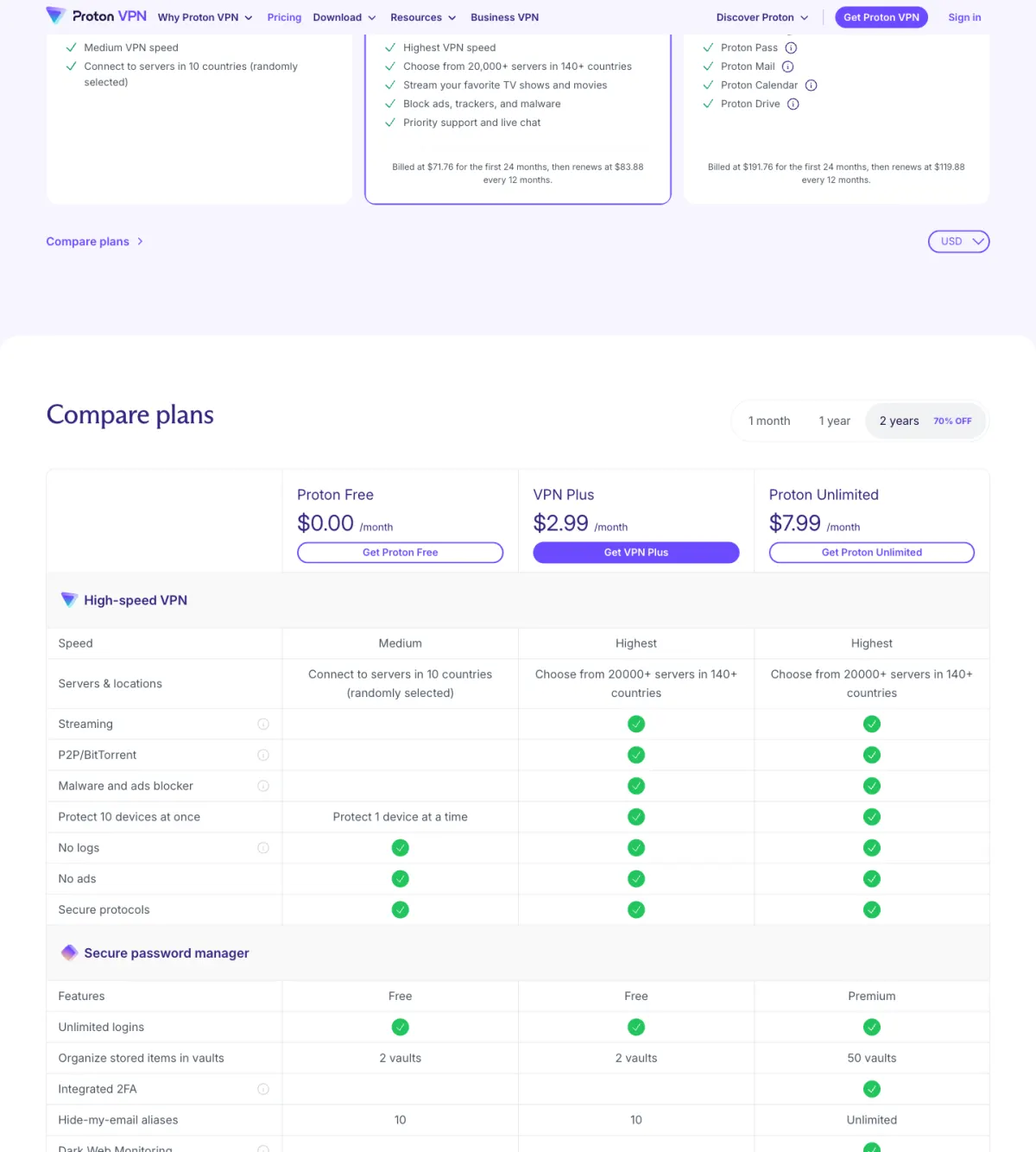
Is Proton VPN's free plan good enough?
This is Proton VPN's standout feature, and it deserves a clear-eyed look.
Most "free" VPNs make their money by logging and selling your activity — which defeats the entire point. Proton's free tier is different: it has no data cap, runs no ads, and is funded by the paid subscriptions rather than by your data. You get servers in about 10 countries and a level of speed that is fine for everyday browsing and protecting an untrusted Wi-Fi connection. For a free product, that is genuinely excellent — it is the best free VPN available, and the rare one we would actually trust.
The honest limits matter, though. The free tier covers one device at a time, speeds are slower than the paid Plus plan, and — most importantly — it carries no guarantee of streaming unblocking. If you are hoping to use the free plan to watch a region-locked catalog, expect disappointment; that is exactly the use case Proton reserves for paid. So "good enough" depends on the job: for private browsing and casual protection, yes, easily; for streaming or covering a household of devices, no — you will want Plus or a streaming-first paid VPN.
What do you get with Proton VPN Plus?
Beyond the free tier, the paid Plus plan ships a feature set that is full rather than padded:
- 10 simultaneous devices on one account — enough for a typical household, matching NordVPN.
- Secure Core — multi-hop routing that passes your traffic through hardened servers in privacy-friendly countries before it exits, raising the bar against network-based deanonymization.
- NetShield — DNS-level blocking of ads, trackers, and known malware domains, included in the subscription.
- Open-source apps across platforms, with independent third-party audits — so the privacy claims are inspectable rather than asserted.
- Swiss jurisdiction — strong privacy law, outside the major surveillance alliances.
- Proton ecosystem fit — it slots in alongside Proton Mail, Drive, and Pass under one account if you are building a privacy-first toolkit.
Is Proton VPN good for streaming?
This is the area where Proton VPN is solid but not the leader, so it is worth being precise.
On the paid Plus plan, Proton VPN unblocks major streaming catalogs reasonably well — it is not a weak streaming VPN. Proton actually has more total servers than NordVPN, but NordVPN covers more distinct city locations and rotates its streaming IPs more aggressively, and in practice that means somewhat less consistent unblocking on Proton across the long tail of services and regions, plus the occasional slower route. Streaming platforms actively hunt and block VPN IP ranges, and the providers that spread across the most locations and rotate IPs most aggressively tend to win that cat-and-mouse game more often — which is where NordVPN's broader location coverage gives it the edge.
The free tier is clearer still: it explicitly does not guarantee streaming unblocking, so do not buy Proton on the strength of the free plan if streaming is your goal. The honest bottom line: if reliable streaming across many services is your primary reason to subscribe, NordVPN is the more consistent pick. If streaming is a nice-to-have on top of a privacy-first setup, Proton Plus is perfectly capable.
Get NordVPN (streaming-first pick)How Proton VPN stacks up
Pros
- The best free tier in the business — no data cap, no ads, not funded by selling your data.
- The strongest privacy pedigree of the mainstream picks: Swiss-based, open-source, independently audited.
- A genuinely full paid feature set: 10 devices, Secure Core multi-hop, and NetShield blocking.
- Strong long-term value on the 1-year ($3.99/mo) or 2-year ($2.99/mo) Plus plan (as of June 2026) — though these are introductory rates that renew higher.
- Fits neatly into the wider Proton privacy ecosystem (Mail, Drive, Pass).
Cons
- Covers fewer distinct city locations than NordVPN, with less consistent streaming-unblocking breadth (despite having more total servers).
- Sometimes a step behind NordVPN on raw speed depending on route.
- The $9.99/mo monthly Plus price is steep — the value requires a 1-2 year commit.
- The free tier is 1 device only and does not guarantee streaming unblocking.
Who should pick something else?
Proton VPN is the right call for a specific buyer, and the wrong shape for others.
For pure streaming, look at NordVPN. If your main reason to buy a VPN is reliably unblocking the widest range of streaming catalogs — and you care about raw speed — NordVPN's broader location coverage and actively rotated streaming IPs make it the more consistent performer. It runs $12.99/mo month-to-month or roughly $3.49/mo on the 2-year Basic tier (higher tiers cost more, as of July 2026), with 10 devices and a proper Fire TV app. There is no free tier, but a 30-day money-back guarantee lets you test it.
Get NordVPNFor maximum anonymity with no account, look at Mullvad. If your priority is leaving the smallest possible footprint, Mullvad takes no email at signup, generates an anonymous account number, and charges a flat €5/mo (~$5.40) with no discounts or upsells. It has no affiliate program, so we earn nothing by naming it — but it is the honest pick for privacy purists. The trade-off: Mullvad openly does not optimize for streaming and is frequently blocked, so it is not a streaming choice.
Stick with the free tier if you only browse. If you just want to protect the occasional coffee-shop connection on one device, Proton VPN free is genuinely good enough — there is no need to pay until streaming, speed, or multiple devices become the goal.
Get Proton VPNFrequently asked questions
Is Proton VPN worth it in 2026?
Is Proton VPN's free plan good enough?
Is Proton VPN good for streaming?
Is Proton VPN worth it vs NordVPN?
Is Proton Unlimited worth it if you already want Proton VPN?
Does Proton VPN's price go up after the first term?
Still deciding? See how the two natural rivals compare head-to-head in Proton VPN vs NordVPN, browse the full field in the best VPNs in 2026, read the other side in is NordVPN worth it, or start with do you actually need a VPN if you are not sure yet.
Related reading

Is NordVPN Worth It in 2026? An Honest Review
A skeptical look at whether NordVPN is worth it in 2026 — the real price gap between monthly and 2-year plans, streaming and speed, the 2018 breach, and who should skip it.
13 min read
Proton VPN vs NordVPN: Which Should You Trust in 2026?
Both run audited no-logs VPNs. Proton VPN has the only free tier worth using, Swiss jurisdiction, and the cheaper renewal; NordVPN wins independent speed tests and packs more extras. Prices verified August 2026.
9 min read

Best VPN for Travel in 2026 (Streaming Abroad, Public Wi-Fi, Region-Locking)
The best VPNs for travel in 2026 — safe hotel and airport Wi-Fi, watching your home streaming catalog abroad, and privacy on untrusted networks. NordVPN for reliable unblocking, Proton VPN for a genuinely usable free tier.
9 min read