We independently score every service with our Experience Index. We may earn a commission if you subscribe through links on this page — it never affects our scores or picks.
Most "cloud storage" is private only in the sense that other users cannot see your files — the provider usually can, because they hold the encryption keys. That is fine for holiday photos and genuinely risky for tax records, legal documents, or anything you would hate to see scanned or subpoenaed. Proton Drive belongs to the stricter category: zero-knowledge, end-to-end encrypted storage where the service mathematically cannot read what you upload. The question this review answers is whether that guarantee is worth the honest costs that come with it — the slower transfers, the sync limitation, the Linux gap — and for which buyer.
Is Proton Drive worth it in 2026?
For anyone who wants default zero-knowledge encryption, yes — with clear eyes about what you trade for it.
Proton Drive's core appeal is that encryption is not an opt-in setting you have to remember to switch on; it is the default and the entire design. Files are encrypted on your device, before upload, using zero-access encryption in which only you hold the keys — so Proton, based in Switzerland, cannot view your data, respond to a request with readable files, or scan your content. Crucially, it does not stop at file contents: filenames and folder metadata are encrypted too, closing a gap that trips up services that encrypt the file body but leak your structure. The apps are open-source and, consistent with Proton's model across its products, independently audited — so the privacy claims are inspectable rather than asserted.
Where Proton Drive is not the obvious pick is raw performance and polish. It is slower on big uploads and downloads than the mainstream clouds, editing a file re-uploads the whole thing, and Linux users still have no native GUI. Those are real costs, not nitpicks. So the worth-it answer splits by what you value:
- Pick it if your files are sensitive and privacy is the reason you are here — Proton Drive is close to the top of the list.
- Skip it if you mostly want the fastest, most frictionless sync for non-sensitive data — a mainstream cloud will serve you better.
How much does Proton Drive cost?
This is the part that decides whether Proton Drive is worth it for you, so read the numbers carefully.
Proton Drive starts free and scales sensibly, and the pricing below is standard list pricing — not the promotional "$1 first month" intro — so it is what you will actually renew at.
- Proton Free — 5GB. Enough to test the apps and the sharing flow before you commit a cent.
- Drive Plus — 200GB — about $3.99/mo billed yearly ($47.88/yr), or $4.99/mo month-to-month. The natural starting paid tier.
- Proton Unlimited — 500GB of Drive — about $9.99/mo billed yearly ($119.88/yr). Bundles Drive with Proton Mail, VPN, Pass, and Calendar, which is where it earns its keep if you want the whole ecosystem.
US pricing as of July 2026 — confirm before subscribing. The important structural point is that Proton uses flat list pricing: Drive Plus renews at the same rate rather than spiking after an introductory term, so the only thing to avoid is mistaking the promotional first-month offer for the ongoing rate.
| Service | Entry paid tier | Encryption model | Open-source? | Jurisdiction | Best for |
|---|---|---|---|---|---|
| Proton Drive | 200GB ~$3.99/mo annual | End-to-end / zero-access, incl. metadata | Yes, audited | Switzerland | Default zero-knowledge privacy |
| Google One | 200GB $2.99/mo (100GB $1.99; 2TB $9.99) | Provider-held keys | No | US | Convenience and Google integration |
| iCloud+ | 200GB $2.99/mo (50GB $0.99; 2TB $9.99) | Opt-in E2E (Advanced Data Protection, off by default) | No | US | Apple-ecosystem convenience |
At the 200GB tier Proton Drive costs a dollar more a month than Google One or iCloud+ — and that dollar is essentially the price of default end-to-end encryption. Whether it is worth it depends entirely on whether the provider holding your keys bothers you: for tax records and legal documents it should; for holiday snapshots it probably does not.
Get Proton Drive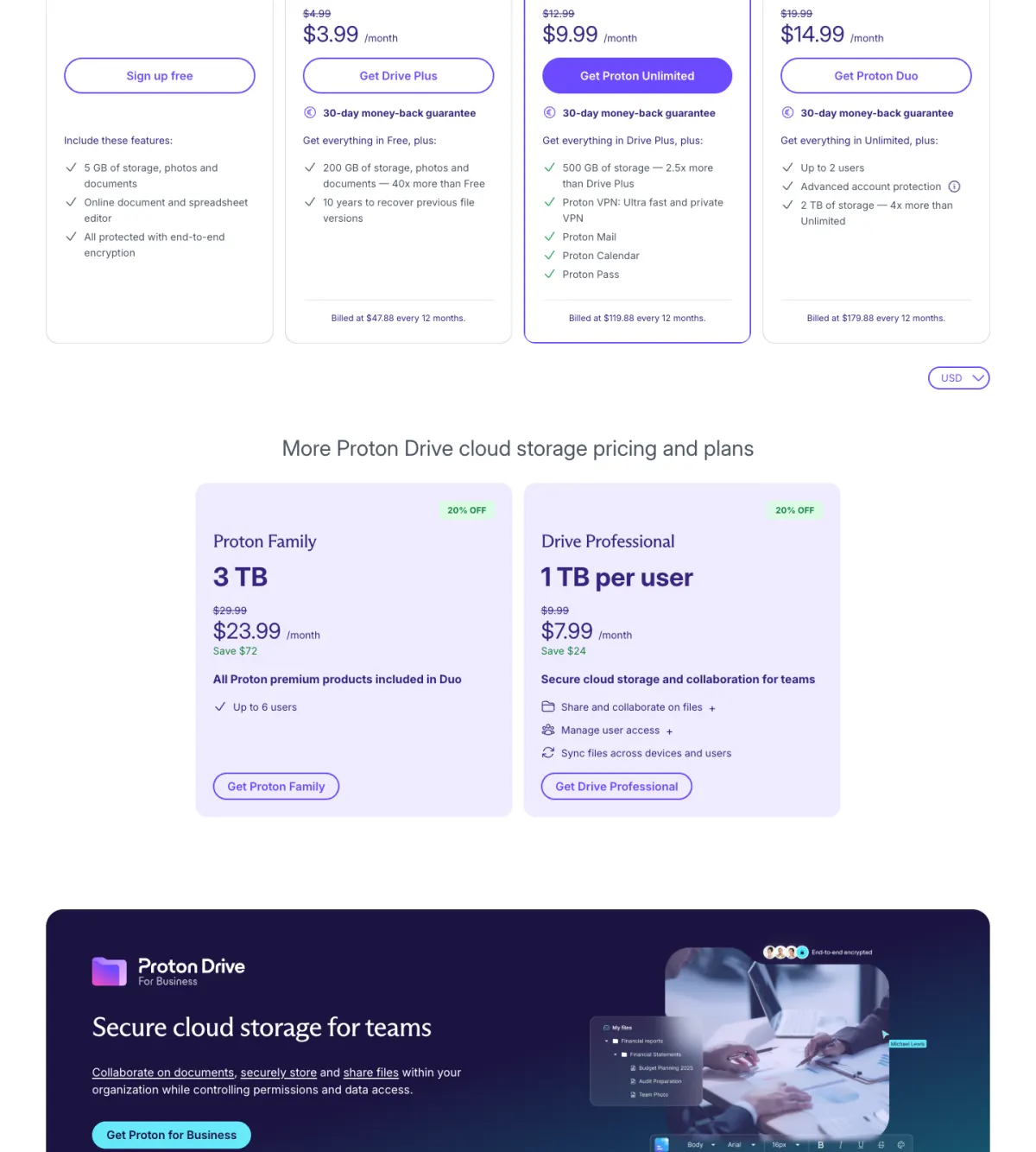
Is Proton Drive really zero-knowledge?
Yes — and the detail worth understanding is how far the encryption reaches.
Plenty of services advertise "encryption," but most encrypt data at rest on their servers using keys they control — which protects you from an outside breach but not from the provider itself. Proton Drive is different: encryption happens on your device, before anything is uploaded, and only you hold the decryption keys. That is what "zero-access" or "zero-knowledge" actually means — Proton cannot read your files even if it wanted to or were compelled to. And it goes a step further than many privacy-first rivals by encrypting filenames and folder structure as well, so your organization does not leak even when the file bodies are protected.
Sharing is handled in the same spirit:
- Encrypted shareable links are generated locally in your browser, with password protection, expiration dates, and one-click revoke.
- Folder sharing comes with view/edit permissions.
- Paid plans keep version history, so you can recover previous versions of a file — useful both for ordinary mistakes and for ransomware recovery.
It is a genuinely usable product, not a privacy toy: there are clients for Web, Windows, macOS, Android, and iOS/iPadOS, plus a command-line tool.
What are the honest trade-offs?
This is where Proton Drive pays for its privacy, and it is worth being precise rather than hand-waving.
The first cost is speed: Proton Drive tends to be slower on raw uploads and downloads than Google Drive or iCloud, because encrypting and decrypting on-device adds work the mainstream clouds skip. The second is sync efficiency: editing a file triggers a full re-upload of the whole file, because there is no block-level delta sync yet — so if you routinely tweak large documents, you will feel it. The third is platform coverage: there is no native Linux GUI client at the time of writing, so Linux users are limited to web access and the CLI. And support is email and knowledge-base only — no live phone or chat.
None of these undoes the privacy case, but they are real, and they define who should look elsewhere. For most privacy-focused users, uploading sensitive files that do not change every hour, these are acceptable costs. For power users hammering large, frequently-edited files, or Linux-desktop holdouts who want a native sync client, they may not be.
Proton Drive — Experience Index
6.9 / 10 composite
Updated Jul 5, 2026
| Dimension | Score | Consensus | Basis |
|---|---|---|---|
| Exit Ease | Moderate consensus | Exit Ease rated 6/10 (moderate consensus): Downgrading keeps existing files (you must first remove data over the new plan limit); over-quota accounts stop syncing/uploading but data is retained up to ~12 months with repeated warnings before any deletion; cancel does not renew. | |
| Price Stability | Moderate consensus | Price Stability rated 8/10 (moderate consensus): Standard list prices (Drive Plus 200GB $3.99/mo billed yearly; Proton Unlimited 500GB $9.99/mo billed yearly) renew at list; only sub-list rate is a labelled $1 intro promo. | |
| Account Sharing | Moderate consensus | Account Sharing rated 9/10 (moderate consensus): End-to-end encrypted shareable links generated client-side, with password protection, expiration dates and one-click revoke; folder sharing and view/edit/comment permissions. | |
| Multi-Device | Moderate consensus | Multi-Device rated 6/10 (moderate consensus): Web, Windows 10/11, macOS, Android, iOS/iPadOS apps plus a CLI; selective sync; no native Linux GUI client yet. | |
| Customer Support | Moderate consensus | Customer Support rated 4/10 (moderate consensus): Knowledge base plus email/ticket support; paid tiers advertise priority support; no phone or live chat. |
How Proton Drive stacks up
Pros
- Genuine end-to-end, zero-access encryption applied on-device — only you hold the keys.
- Encrypts filenames and folder metadata, not just file contents.
- Open-source apps, independently audited, with Swiss jurisdiction behind them.
- Strong encrypted sharing: password-protected, expiring, revocable links plus folder permissions.
- Version history on paid plans for recovering previous file versions.
- Free 5GB tier and a fair-value 200GB plan at about $3.99/mo annual, on flat pricing that does not spike at renewal.
Cons
- Slower raw upload and download speeds than the mainstream clouds.
- Editing a file re-uploads the whole file — there is no block-level delta sync yet.
- No native Linux GUI client at the time of writing (web plus a CLI only).
- Support is email/knowledge-base only — no live phone or chat.
Who should pick something else?
Proton Drive is the right call for a specific buyer and the wrong shape for others.
For convenience over default encryption, look at the mainstream clouds. If your data is not especially sensitive and you want the fastest sync and deepest ecosystem integration, Google One (200GB $2.99/mo) or iCloud+ (200GB $2.99/mo) are faster and cheaper — just remember they hold the keys by default (iCloud's Advanced Data Protection adds end-to-end encryption but is opt-in and off by default). See our Proton Drive vs iCloud vs Google One comparison for that decision in full.
For a native Linux desktop or fastest heavy-file sync, look elsewhere for now. If you live on Linux and want a native GUI sync client, or you constantly edit very large files and cannot stomach whole-file re-uploads, Proton Drive's current limitations will chafe.
Buy Proton Drive if privacy is the reason you are here. For sensitive files, default zero-knowledge encryption with encrypted metadata, open-source audited apps, and Swiss jurisdiction is exactly the guarantee you want — and start on the free 5GB tier before committing.
Get Proton DriveFrequently asked questions
Is Proton Drive worth it in 2026?
Is Proton Drive really zero-knowledge?
How much does Proton Drive cost?
What is the catch with Proton Drive?
Want the broader picture? See how Proton Drive leads the field in our guide to the best private cloud storage in 2026, then weigh it against the defaults in Proton Drive vs iCloud vs Google One. If you are building a fuller privacy toolkit, the Proton Unlimited bundle folds 500GB of Drive in with Mail, VPN, and Pass — and our guide to the best privacy subscriptions in 2026 ties the whole stack together.