
We independently score every service with our Experience Index. We may earn a commission if you subscribe through links on this page — it never affects our scores or picks.
There are two very different reasons people use Google: because it is convenient, and because it is free-feeling and already there. Neither is a privacy argument. Google's model is to hold the keys to your data so it can index, search, and integrate across Gmail, Drive, Photos, and the rest — brilliant for convenience, and the opposite of private. Proton's whole pitch is the inverse trade: give up some integration and raw storage in exchange for end-to-end encryption where only you hold the keys. This comparison walks the swap product by product, lands on the clean 1:1 at the $9.99/mo tier, and is honest about the one place Proton cannot yet follow you.
The core difference: who holds the keys
Before comparing products, it is worth naming the single distinction that drives everything else — who holds the encryption keys to your data.
Google's services are built around provider-held keys. Your Gmail, Drive files, and Photos are encrypted at rest on Google's servers, but Google controls those keys. That is not a scandal; it is the design, and it is what makes Google's conveniences possible — server-side search across your whole inbox, instant web previews, smart suggestions, easy account recovery, and deep cross-product integration all require the provider to be able to read your data. The cost is that Google can read it, respond to a legal request with readable content, and use it to inform its products.
Proton's services are built around zero-access (zero-knowledge) encryption. Your email, files, and passwords are encrypted on your device before they reach Proton's servers, and only you hold the keys — so Proton cannot read your content even if compelled. Proton's apps are open-source and independently audited, and the company is based in Switzerland, outside the major surveillance alliances and under strong privacy law. The cost is the mirror image of Google's benefit: you give up some server-side convenience and integration to get a guarantee that your data stays yours.
That trade — convenience-with-access versus privacy-without — is the whole comparison. Everything below is just its consequences product by product.
Product by product: the Google-to-Proton swap
Here is how each Google service maps to a Proton one, and how clean each swap actually is.
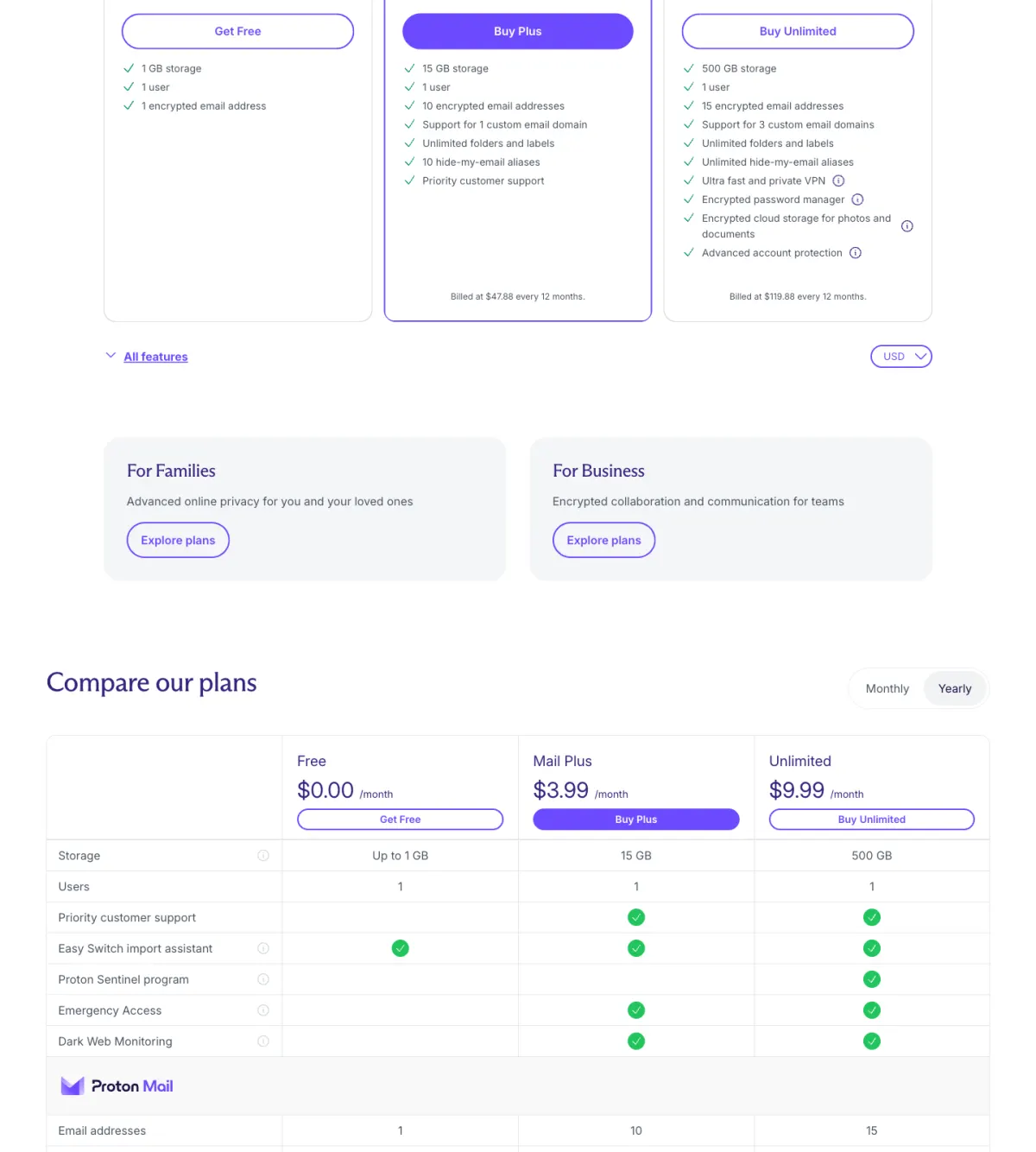
- Gmail to Proton Mail. Proton Mail is the flagship: end-to-end encrypted email, free tier available, or Mail Plus at about $3.99/mo standalone (US pricing as of July 2026 — confirm before subscribing), and folded into Unlimited. The swap is clean for everyday email; you keep a private inbox Proton cannot read. You do give up Gmail's deep integration with the rest of Google.
- Google Drive and Photos to Proton Drive. Google Drive storage moves to Proton Drive, with end-to-end encryption covering filenames and folder metadata, not just file contents. Photos back up as encrypted files rather than into a dedicated Photos experience — a genuine functional downgrade if you lean on Google Photos' search and albums, but a privacy upgrade for the underlying files.
- Google Calendar to Proton Calendar. A clean, encrypted swap included in the paid Proton tiers.
- Google One to Proton Unlimited. This is the anchor comparison, covered in full below.
- Add Proton VPN. Google never sold you network-level privacy; Proton VPN adds it — Swiss, open-source, audited, with Secure Core multi-hop and NetShield blocking. It is the one piece with no Google equivalent at all.
The productivity layer is where the map breaks down. Google Docs, Sheets, and Slides — and especially real-time collaborative editing — have no full Proton equivalent. If your life runs on shared Google Docs, that piece needs a separate plan; Proton is a clean swap for email, files, and calendar, not for collaborative document editing.
The clean 1:1 — Proton Unlimited vs Google One 2TB
The two plans people actually weigh against each other both sit at $9.99/mo, which makes the trade unusually easy to see.
Google One at 2TB is $9.99/mo and buys you exactly one thing done very well: a large, shared pool of storage across Drive, Gmail, and Photos, with Google's keys and Google's convenience. Its smaller tiers — 100GB at $1.99/mo and 200GB at $2.99/mo — undercut Proton on price at the low end, but none of them are encrypted zero-knowledge.
Proton Unlimited is about $9.99/mo (roughly $119.88/yr) and buys you a different thing entirely: 500GB of end-to-end encrypted Drive storage plus Proton Mail, VPN, Pass, and Calendar under one account. You get one quarter of Google One's raw storage, but every byte is encrypted with keys only you hold, and you get a VPN and password manager that would otherwise be separate purchases. Proton also uses flat list pricing, so it renews at the same rate rather than spiking.
| Feature | Proton Unlimited | Google One 2TB |
|---|---|---|
| Headline price | ~$9.99/mo (flat, renews same) | $9.99/mo |
| Storage | 500GB, end-to-end encrypted | 2TB, provider-held keys |
| Who holds the keys | You only (zero-access) | |
| Proton Mail (E2E) included | Gmail (provider-held keys) | |
| VPN | Proton VPN Plus included | None |
| Password manager | Proton Pass Plus included | None |
| Open-source / audited | Yes | No |
| Jurisdiction | Switzerland | US |
| Collaboration (Docs/Sheets) | No full equivalent | Full Google Workspace |
Read the chart honestly: on pure storage-per-dollar, Google One wins four to one. Proton's answer is not more gigabytes — it is encrypted gigabytes plus two extra privacy tools in the box. If storage volume is your need, Google One is the better buy; if the point is that no one but you can read your files, email, and passwords, Proton Unlimited is worth the smaller locker.
Proton Drive — Experience Index
6.9 / 10 composite
Updated Jul 5, 2026
| Dimension | Score | Consensus | Basis |
|---|---|---|---|
| Exit Ease | Moderate consensus | Exit Ease rated 6/10 (moderate consensus): Downgrading keeps existing files (you must first remove data over the new plan limit); over-quota accounts stop syncing/uploading but data is retained up to ~12 months with repeated warnings before any deletion; cancel does not renew. | |
| Price Stability | Moderate consensus | Price Stability rated 8/10 (moderate consensus): Standard list prices (Drive Plus 200GB $3.99/mo billed yearly; Proton Unlimited 500GB $9.99/mo billed yearly) renew at list; only sub-list rate is a labelled $1 intro promo. | |
| Account Sharing | Moderate consensus | Account Sharing rated 9/10 (moderate consensus): End-to-end encrypted shareable links generated client-side, with password protection, expiration dates and one-click revoke; folder sharing and view/edit/comment permissions. | |
| Multi-Device | Moderate consensus | Multi-Device rated 6/10 (moderate consensus): Web, Windows 10/11, macOS, Android, iOS/iPadOS apps plus a CLI; selective sync; no native Linux GUI client yet. | |
| Customer Support | Moderate consensus | Customer Support rated 4/10 (moderate consensus): Knowledge base plus email/ticket support; paid tiers advertise priority support; no phone or live chat. |
Where Google still wins
A fair comparison names the other side's strengths plainly, and Google has several that Proton cannot match today.
Collaboration and productivity. Google Docs, Sheets, and Slides — with real-time multi-user editing, comments, and revision history — are a genuine category leader with no full Proton equivalent. For anyone whose work runs on shared documents, this alone can be a dealbreaker.
Integration and convenience. Because Google holds your keys, it can offer instant search across your entire inbox and drive, smart replies, photo search by content, and seamless handoff between products. Proton's encryption forecloses some of that by design; you trade the convenience for the privacy.
Raw storage per dollar. Four times the storage at the same 2TB-tier price, and cheaper small tiers (100GB at $1.99/mo, 200GB at $2.99/mo). If you just need a big, cheap bucket for non-sensitive data, Google One is the value pick.
Photos as an experience. Google Photos' organization, search, and sharing is a product in its own right; Proton Drive stores photo files privately but does not replicate that experience.
Who should switch, and who should not
Switch to Proton if privacy is the actual motivation — you want your email, files, calendar, and passwords encrypted with keys only you hold, from an open-source, audited, Swiss provider, and you are willing to trade raw storage and some integration for it. The Proton Unlimited tier makes the swap a single decision rather than four.
Stay with Google (or split the difference) if you live in Google Docs collaboration, need the largest cheap storage pool, or value seamless cross-product integration above default encryption. A common honest middle path is to move the sensitive pieces — email and private files — to Proton while keeping Google for collaborative documents.
Get Proton (Unlimited)Frequently asked questions
Is Proton better than Google for privacy?
What is the Proton equivalent of Google One?
Can Proton replace my whole Google account?
Does switching from Google to Proton cost more?
Going deeper on any one piece? See how the storage side compares in Proton Drive vs iCloud vs Google One, weigh the VPN on its own in is Proton VPN worth it, and run the bundle math in is Proton Unlimited worth it. To see how the whole Proton stack fits together, start with our guide to the best privacy subscriptions in 2026.