
We independently score every service with our Experience Index. We may earn a commission if you subscribe through links on this page — it never affects our scores or picks.
The pitch is seductive: get the right card and your Disney+, your Hulu, your YouTube Premium comes "free." The reality is narrower and more honest. A subscription credit is a coupon — a monthly allowance the issuer will reimburse you for, but only against specific services, only when you buy them a specific way, and in most cases only after you have flipped an enrollment switch that nobody reminds you about. Get all of that right and the value is real. Get any of it wrong and you are paying full price while telling yourself you have a deal. This is a plain inventory of which 2026 cards actually pay toward subscriptions, exactly what they cover, and the catch attached to each — written for people who already subscribe and want to stop leaving money on the table without being sold a fantasy.
The real statement credits: what actually reimburses you
Two Amex products stand out as cards that genuinely hand money back against subscriptions — as long as you subscribe to the right services and turn the benefit on.
The Platinum Card from American Express — Digital Entertainment Credit
As of July 2026, the Platinum carries a Digital Entertainment Credit of up to $25 per month — up to $300 a year — applied as a statement credit against eligible purchases. Enrollment is required; the credit does not apply until you activate it in your account. The current eligible list, refreshed in 2025, covers purchases at Disney+, the Disney Bundle, ESPN (streaming), Hulu, The New York Times, Paramount+, Peacock, The Wall Street Journal, YouTube Premium, and YouTube TV. That is the whole list — services that are not on it (for example Audible or SiriusXM) simply do not trigger the credit, so do not assume broader coverage than the issuer states.
Services that are not on the list simply do not trigger the credit — so do not assume broader coverage than the issuer states.
The critical context: the Platinum's annual fee is $895 as of July 2026. That reframes the credit entirely. The $300 of digital entertainment value is not "free money" layered on top of a cheap card — it is one of several credits designed to offset a very large fee. If you are evaluating the Platinum, the honest question is whether the full stack of credits you will actually use exceeds $895, not whether $25 a month of streaming sounds nice in isolation. We walk through that style of math in the $550 travel-card annual-fee breakeven, and the same discipline applies here at a bigger number.
If YouTube Premium is your anchor service, it is worth understanding what you are actually paying for before you assign a credit to it — our take on whether YouTube Premium is worth it covers that.
Amex Blue Cash Preferred — two separate streaming benefits
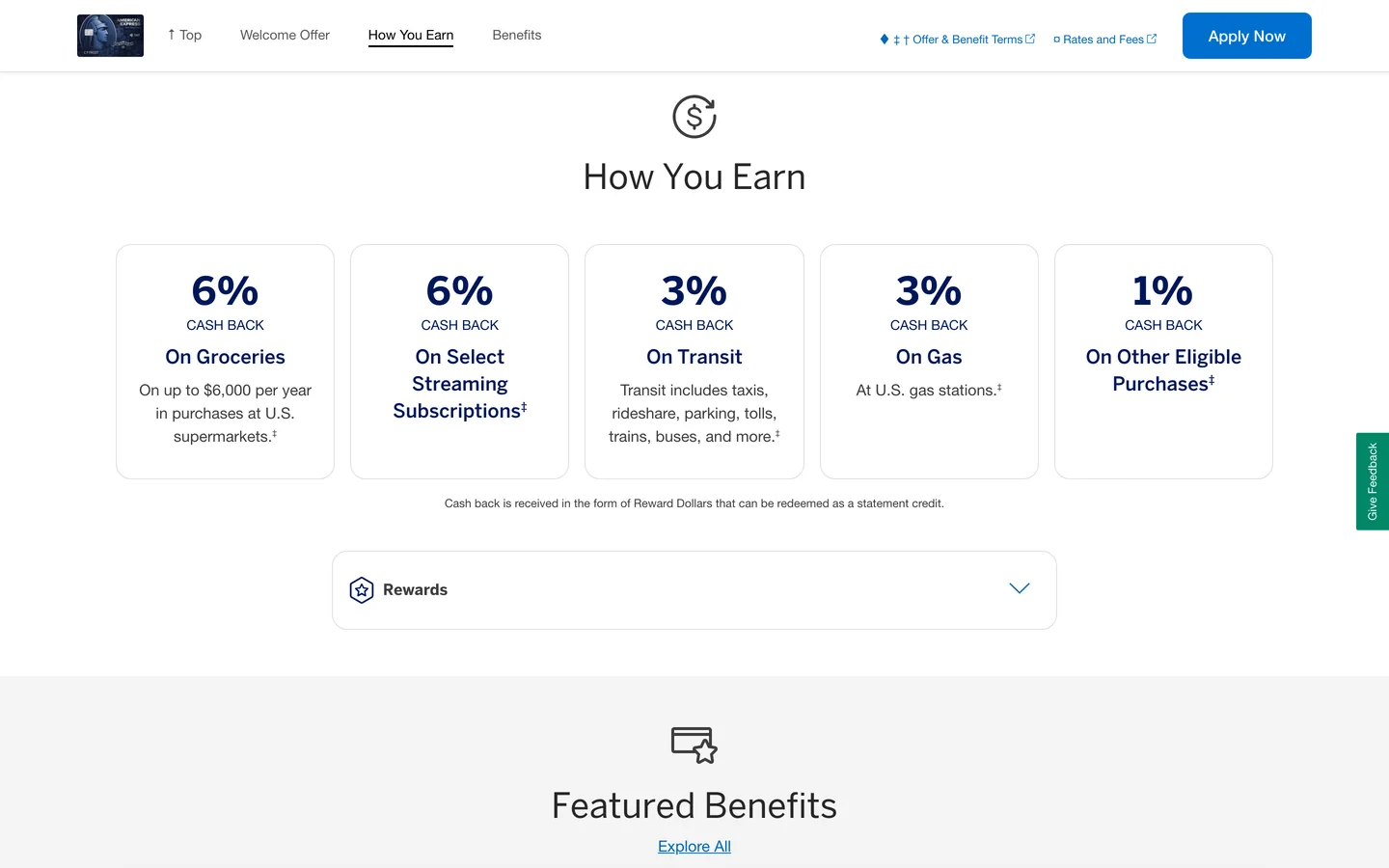
The Blue Cash Preferred is the more approachable option, and it stacks two distinct streaming perks. First, as of July 2026 it earns 6% cash back on select U.S. streaming subscriptions — that reward is automatic on the category, no enrollment needed. Second, and separately, it carries a Disney Streaming Credit of up to $10 per month (up to $120 a year) on Disney+, Hulu, or ESPN+ purchased directly — and that one requires enrollment. The annual fee is $0 the first year, then $95.
Because the 6% is a rewards rate and the $10 is a credit, they are not the same benefit and do not cancel each other out. But the same buy-direct rule applies to the credit: purchase through the provider, not a third-party app store, or the credit may not post.
The Amex Gold does not cover streaming
This is the correction worth making loudly. The American Express Gold Card is frequently assumed to "cover streaming." It does not. As of July 2026, the Gold's monthly statement credits are for dining, Uber, Dunkin, and a hotel credit — there is no streaming or digital entertainment credit on it at all. If streaming reimbursement is your goal, the Gold is the wrong card; that benefit lives on the Platinum and the Blue Cash Preferred.
The bonus-category cards: rewards on the spend, not a credit
Several cards do not reimburse your subscription — they pay you a slightly higher rewards rate when you charge it. That is real value, but it is a different mechanism, and it is easy to conflate the two.
- Chase Sapphire Preferred — earns 3x points on select streaming services as a bonus category (not a statement credit). As of July 2026 it also offers a complimentary Apple TV promotional subscription when activated, running through 2026. Annual fee $95.
- Citi Strata — the base Strata card lets you earn 3x ThankYou points on a self-selected "Select Streaming Services" bonus category. The catch is in the word self-selected: you have to actively choose streaming as your category for it to apply.
- Citi Double Cash — earns a flat 2% on everything, streaming included. No category to manage, no enrollment — the simplest way to get a modest, guaranteed return on subscription spend.
- U.S. Bank Cash+ — industry-reported to let you choose a 5% category that can include TV, internet, or streaming billed directly by the provider. Present this as reported and note the familiar limitation: third-party app-store billing often does not qualify.
One card deserves a footnote rather than a recommendation. The Citi Custom Cash historically gave 5% on your top eligible spend category each month (which could be streaming) up to a monthly cap — but as of May 28, 2026 it is closed to new applicants. If you already hold one, that 5% may still be worth pointing at streaming; if you do not, it is no longer a card to go get.
| Card | Subscription benefit | Amount / rate | Enrollment required? |
|---|---|---|---|
| Amex Platinum | Digital Entertainment Credit (fixed list of eligible services) | Up to $25/mo (up to $300/yr) | Yes |
| Amex Blue Cash Preferred | 6% cash back on select U.S. streaming | 6% (category) | No |
| Amex Blue Cash Preferred | Disney Streaming Credit (Disney+, Hulu, ESPN+, bought direct) | Up to $10/mo (up to $120/yr) | Yes |
| Amex Gold | None — no streaming credit exists on this card | — | — |
| Chase Sapphire Preferred | 3x points on select streaming (bonus category) | 3x points | No (Apple TV perk needs activation) |
| Citi Strata | 3x ThankYou on self-selected streaming category | 3x points | Must self-select the category |
| Citi Double Cash | Flat 2% on everything, streaming included | 2% | No |
| U.S. Bank Cash+ | Choosable 5% category incl. TV/internet/streaming (as reported) | 5% (as reported) | Must choose the category |
| Citi Custom Cash | 5% on top category (can be streaming), capped — existing holders only | 5% (capped) | Closed to new applicants as of May 28, 2026 |
The AI-subscription angle, honestly
It is tempting to imagine a card that pays for your ChatGPT or Claude subscription. As of July 2026, none exists. There is no card with a dedicated AI-subscription statement credit — not for ChatGPT, not for Claude, not for Copilot.
What exists is indirect and worth stating plainly so nobody is misled. A flexible cash-back or bonus-category card can earn its ordinary rewards when an AI subscription posts as a normal purchase, and business cards with an office-supply or software-spend category can do the same for work tools. But that is earning points on the spend, exactly as you would on any recurring charge — not a targeted credit that zeroes out the bill. If you are budgeting around AI tools, treat them like any other subscription for rewards purposes and read our rundown of the best AI subscriptions in 2026 to decide what is actually worth paying for in the first place.
The honest catch: why a "credit" is often worth $0
The through-line is simple: these benefits reward the organized. If you enroll on day one, subscribe directly, and either automate or diarize the monthly usage, the value is real and repeatable. If any of those steps slips, you are paying full freight with a false sense of a deal. Before you attach a credit to a service, it is also worth confirming the service earns its place in your budget at all — our guide to the best streaming services in 2026 is a good gut-check, as is our look at the best Amazon subscriptions worth it in 2026 if Prime and its add-ons are in your mix.
Who should chase a subscription-credit card?
Pros
- You already pay for services on the card's eligible list (e.g. Disney+, Hulu, YouTube Premium, Paramount+) — the credit reimburses spending you would incur anyway.
- You are organized enough to enroll once and use the credit every month without being reminded.
- You subscribe directly through providers, not through app-store billing.
- On a high-fee card, the subscription credit is one of several credits whose combined value you have confirmed exceeds the fee.
Cons
- You would be subscribing to a service only to "use up" a credit — that is spending money to save less money.
- You tend to forget monthly benefits, in which case use-it-or-lose-it credits quietly become $0.
- Your subscriptions are billed through the App Store or Google Play and cannot easily be moved to direct billing.
- You are drawn to a high-fee card for the streaming credit alone, without the rest of its credit stack clearing the fee.
Frequently asked questions
Which credit cards actually pay for your subscriptions in 2026?
Does the Amex Gold card cover streaming?
Is there a credit card with a ChatGPT or AI subscription credit?
Why do you have to enroll for a streaming credit you already qualify for?
Do these subscription credits work if you pay through the App Store or Google Play?
Keep reading before you assign a credit to anything: sanity-check the services first with our guide to the best streaming services in 2026 and, if YouTube Premium is your anchor, whether YouTube Premium is worth it. For the software side, see the best AI subscriptions in 2026, and if you are weighing a high-fee card for its credit stack, run the numbers with the $550 travel-card annual-fee breakeven.