Review🎬 Video Streaming
Is Amazon Prime Worth It in 2026? An Honest Decision Guide
A skeptical look at whether Amazon Prime is worth $14.99/month in 2026 — the full bundle of perks, the "worth it just for shipping?" math, and who should skip it.
Checked against primary sources, July 2026 · How we verify
We independently score every service with our Experience Index. We may earn a commission if you subscribe through links on this page — it never affects our scores or picks.
Amazon Prime is the subscription most people stop questioning — they signed up for free shipping years ago and never did the math again. But Prime is really a dozen services stapled together, and whether it is "worth it" depends entirely on how many of those services you actually use. This guide breaks down what is in the bundle, runs the "worth it just for shipping?" math, and sorts out who Prime overcharges in 2026.
Is Amazon Prime worth it in 2026?
For regular Amazon shoppers, yes — comfortably. For people who order a few times a year and ignore the apps, no. The honest calculation hinges on two questions: how often do you order from Amazon, and will you actually use any of the bundled perks?
Prime's headline benefit is still fast, free shipping — same-day or one-day delivery in many areas, two-day almost everywhere, with no order minimum. For a household that orders from Amazon a couple of times a month, that alone goes a long way toward the fee. But shipping is only the entry ticket. The reason Prime is sticky is everything bundled on top: Prime Video (a full streaming service), Amazon Music, Prime Reading, Amazon Photos, Whole Foods and Grubhub perks, and Prime Gaming. That cuts both ways — it adds genuine value if you use the perks, but it is also why people keep paying out of habit after they have stopped. If you actually use even one of those regularly, the value equation tilts toward "keep it."
The trap is the opposite case. If you order from Amazon rarely, never open Prime Video, and would not miss Amazon Music or Prime Reading, you are paying about $139 a year for occasional faster shipping you could buy à la carte. Prime is one of those subscriptions that quietly renews for people who stopped getting value from it — which is exactly why so many people end up cancelling Amazon Prime.
How much does Amazon Prime cost in 2026?
The pricing is simpler than Amazon's reading and audio products, with a meaningful annual discount and two reduced-rate paths.
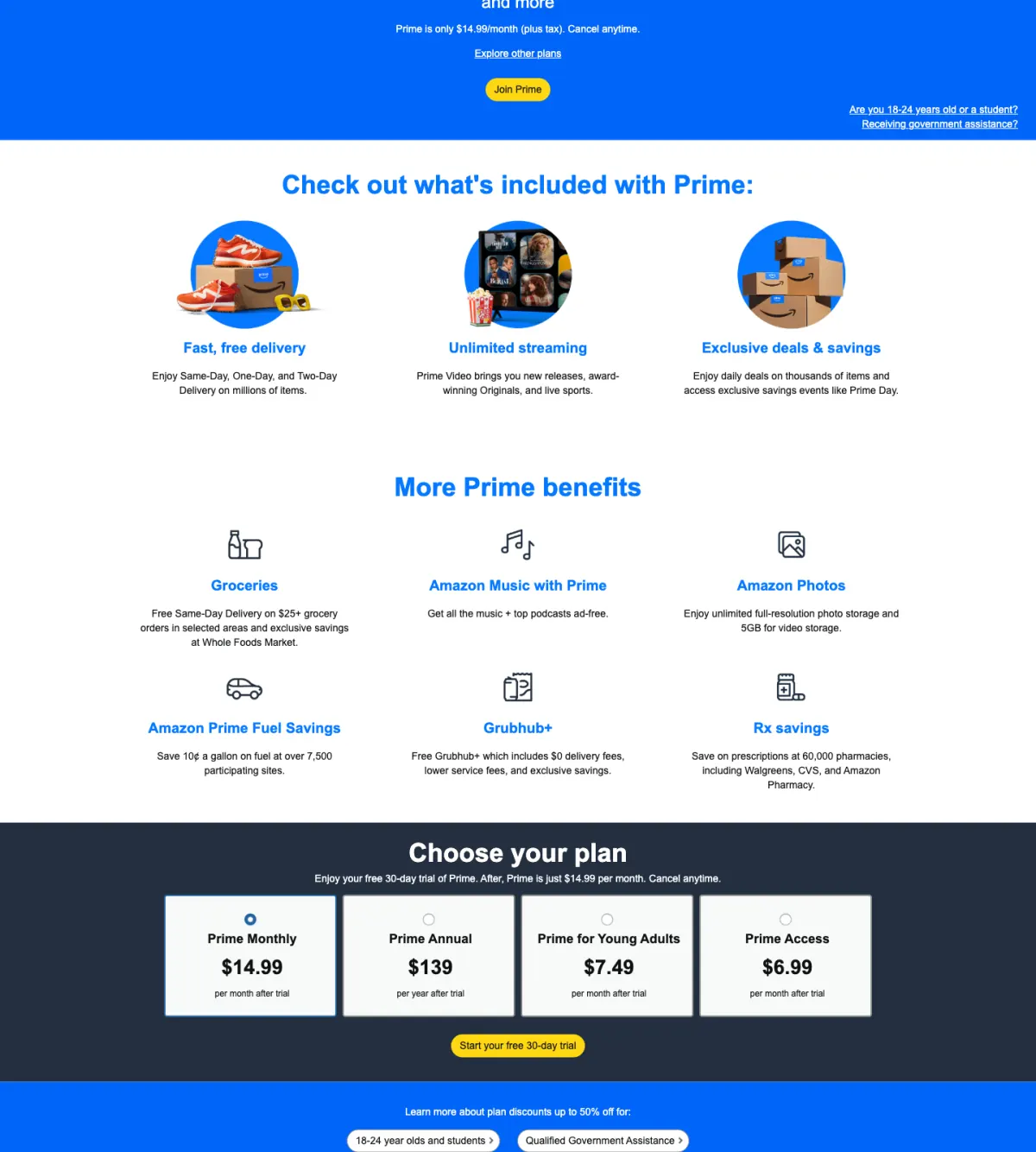
The standard rate is about $14.99/month or $139/year (as of June 2026). Paying annually works out to roughly $11.58 a month — about $40 cheaper over the year than paying month to month, so anyone keeping Prime long term should pay yearly. If you only want the shows, Amazon sells a standalone Prime Video membership for about $8.99/month without the rest of Prime — but note that tier (like the Prime Video included with a membership) is ad-supported; going fully ad-free or unlocking 4K/Dolby Atmos costs an extra $4.99/month via Prime Video Ultra. Students get a deep discount: Prime Student is $7.49/month or $69/year after a six-month free trial, with student verification. And qualifying low-income shoppers — including many on EBT, SNAP, or Medicaid — can get Prime through Prime Access at $6.99/month (50% off the standard rate); Prime Access is monthly-only, with no annual option.
| Plan | Price | What you get | Best for |
|---|---|---|---|
| Prime (annual) | Full bundle: shipping + all perks | Year-round Amazon households | |
| Prime (monthly) | ~$14.99/mo | Full bundle, cancel anytime | Flexible or seasonal members |
| Prime Student | $7.49/mo or $69/yr | Full bundle at a student rate (after 6-mo trial) | Verified college students |
| Prime Access (low-income) | $6.99/mo (monthly only) | Full bundle at 50% off | Qualifying EBT/SNAP/Medicaid shoppers |
| Prime Video only | ~$8.99/mo (ad-supported) | Streaming only; ad-free + 4K is +$4.99/mo (Ultra) | People who only want the shows |
What is included with Amazon Prime?
This is the part people forget when they ask whether Prime is "worth it." You are not buying shipping — you are buying a bundle, and the perks below all come at no extra cost on top of the membership:
- Fast, free shipping — same-day or one-day in many areas, two-day almost everywhere, with no order minimum. This is the anchor benefit.
- Prime Video — a full streaming service with originals, movies, and TV included; comparable to the standalone plan (about $8.99/month), but the bundled version is ad-supported. Going fully ad-free or getting 4K/Dolby Atmos requires the separate Prime Video Ultra add-on at an extra $4.99/month, so treat it as worth a bit less than a clean $8.99 swap.
- Amazon Music — the ad-free Prime music tier, with a large catalog for casual listening (a step below the full Amazon Music Unlimited).
- Prime Reading — a rotating library of roughly 3,000 ebooks and magazines you can borrow at no extra charge (this is not the paid Kindle Unlimited).
- Amazon Photos — unlimited full-resolution photo storage for the account holder (plus 5 GB for videos), a genuine perk if you have a large photo library.
- Whole Foods & Grubhub perks — exclusive member discounts at Whole Foods plus a complimentary Grubhub+ membership for delivery (terms vary).
- Prime Gaming — free games and in-game loot each month, plus a free Twitch channel subscription, bundled in for gamers.
The takeaway: if even one of these is something you would otherwise pay for, Prime's effective cost drops fast. A household that would buy Prime Video anyway is essentially getting the shipping and everything else for the difference between Prime and the standalone Video plan — just remember the bundled Video is ad-supported, so it is not a perfect dollar-for-dollar substitute for the ad-free standalone tier.
Is Amazon Prime worth it just for shipping?
This is the single most-searched question about Prime, so here is the plain math.
At about $139/year, Prime costs roughly $11.58 a month. Amazon's free-shipping threshold for non-members is a minimum order (commonly around $35 of eligible items), and orders below that — or anything you want faster than standard — incur a delivery fee that can run several dollars each. If you place roughly two or more orders a month that would otherwise cost a shipping fee or fall under the free-shipping minimum, Prime pays for itself on shipping alone. Order weekly and it is not close — you save far more than the fee.
But "just for shipping" is the wrong frame for most people. The honest answer is that shipping rarely needs to justify Prime by itself, because the bundled perks pile on top. If you actually watch Prime Video — and don't mind the ads on the included tier — the shipping math matters a lot less, because you'd otherwise pay for streaming anyway. The people for whom "just for shipping" genuinely fails are light shoppers who place a handful of orders a year and ignore every other perk. For them, paying per-order shipping or hitting the free-shipping minimum is cheaper than an annual membership.
Who should buy Amazon Prime, and who should skip it?
Prime earns its fee for a specific household and overcharges everyone else.
Pros
- Fast, free shipping with no order minimum — pays for itself with regular ordering.
- A genuinely deep bundle: Prime Video, Amazon Music, Prime Reading, Photos, Whole Foods/Grubhub perks, and Prime Gaming all included.
- The annual plan (~$11.58/month) is meaningfully cheaper than monthly, and the included Prime Video offsets much of the cost for regular streamers.
- Real discounts exist for students ($7.49/month) and qualifying low-income shoppers (Prime Access at $6.99/month).
- Easy to downgrade to Prime Video standalone (~$8.99/month, ad-supported) if shipping is all you would lose.
Cons
- Poor value if you order from Amazon only a few times a year and ignore the perks.
- The price has crept up over the years; $139/year is a real recurring cost to justify.
- It is easy to keep paying out of habit long after you stop using it.
- Several perks (Prime Music, Prime Reading) are deliberately lighter than Amazon's paid upgrades (Music Unlimited, Kindle Unlimited).
- The included Prime Video shows ads, and ad-free viewing or 4K now costs an extra $4.99/month via Prime Video Ultra.
- Whole Foods and shipping value depends heavily on where you live and how you shop.
Buy Prime if you order from Amazon at least a couple of times a month, or if you would use even one of the bundled perks — especially Prime Video — that you would otherwise pay for separately. For a typical Amazon-reliant household, the annual plan is one of the easier subscriptions to justify: the more perks you genuinely use, the better the value gets. The flip side is the trap — if you stop touching the perks, the same bundle is just a recurring charge worth re-examining at renewal. And if you're keeping it, pay for it (and the rest of your Amazon habit) on a card that rewards Amazon spend — here's which cards pay you back on Prime and Amazon purchases.
Skip it if you are a rare Amazon shopper who would never open the apps. If shipping is the only thing tempting you, price out per-order shipping or simply batch your orders over the free-shipping minimum. And if you only want the shows, drop full Prime and keep the standalone Prime Video plan — see Prime Video channels vs standalone subscriptions to make sure you are not double-paying for add-ons.
Start your Amazon Prime trialFrequently asked questions
Is Amazon Prime worth it in 2026?
Is Amazon Prime worth it just for shipping?
Is Amazon Prime worth it for seniors?
Is Amazon Prime worth it for Whole Foods?
Still deciding? If you are weighing whether to leave, our guide on how to cancel Amazon Prime covers the refund rules and how to keep just the shows. To compare the streaming side, see Prime Video channels vs standalone subscriptions. And if it is really Amazon's reading and audio perks you are after, check whether Kindle Unlimited is worth it, whether Audible is worth it, or how the two stack up in Audible vs Kindle Unlimited. For how these services handle price changes and cancellations over time, browse our Experience Index.
Related reading

Are Amazon's Subscriptions Worth It? Prime, Prime Video, Audible & Kindle Unlimited (2026)
One hub to untangle what you actually pay Amazon: Prime bundles Prime Video, but Audible and Kindle Unlimited are separate paid subs. Here's what's included, what isn't, and which are worth it in 2026.
10 min read
Best Support When Your Subscription Breaks in 2026
Live chat vs email-only vs phone, and whether a human actually answers, across the nine subscriptions we track — NordVPN, Proton VPN, NordPass, Proton Pass, Proton Drive, Amazon Prime, Audible, Kindle Unlimited, and Prime Video — as of July 2026.
14 min read
How Many Devices Does Your Subscription Actually Cover in 2026?
The real simultaneous-connection and active-device caps behind nine subscriptions we track — VPNs, password managers, encrypted cloud, Amazon Prime, Audible, and Kindle Unlimited — and exactly where households hit the wall, as of July 2026.
13 min read