
We independently score every service with our Experience Index. We may earn a commission if you subscribe through links on this page — it never affects our scores or picks.
Transfer partners are the reason a flexible currency like Membership Rewards can be worth far more than its cash-out value — but only if the transfer is done deliberately. Move points to the wrong program, at the wrong ratio, or before confirming a seat exists, and the flexibility works against you, because a transfer is one-way and final. What follows is a plain map of who Amex partners with, at what ratio, where the recent cuts landed, and where the durable value tends to sit. The mechanics and the airline fee below are drawn from Amex's own Membership Rewards terms as of July 2026; the ratios are the rates widely reported across the points community, to be confirmed in your own transfer portal.
The full partner map
As of July 2026, Amex Membership Rewards spans a broad airline lineup plus three hotel programs. The table below groups partners by ratio, because the ratio is where the value — and the catches — actually live. Remember that Amex gates these exact rates behind login: each is the rate widely reported across the points community, and it should be confirmed in your own Membership Rewards transfer portal before you move anything.
| Partner | Type | Ratio (Amex : partner) | Note |
|---|---|---|---|
| Aer Lingus AerClub | Airline | 1:1 | |
| Air Canada Aeroplan | Airline | 1:1 | |
| Air France/KLM Flying Blue | Airline | 1:1 | |
| ANA Mileage Club | Airline | 1:1 | Star Alliance sweet spot |
| Avianca LifeMiles | Airline | 1:1 | |
| British Airways Club (Avios) | Airline | 1:1 | |
| Delta SkyMiles | Airline | 1:1 | U.S. carrier — excise-tax fee applies |
| Iberia Plus (Avios) | Airline | 1:1 | |
| Qatar Airways Privilege Club (Avios) | Airline | 1:1 | |
| Singapore Airlines KrisFlyer | Airline | 1:1 | |
| Virgin Atlantic Flying Club | Airline | 1:1 | |
| Marriott Bonvoy | Hotel | 1:1 | |
| Choice Privileges | Hotel | 1:1 | Relatively recent addition |
| Aeromexico Rewards | Airline | 1:1.6 | Above parity — the rare bonus |
| Hilton Honors | Hotel | 1:2 | Doubles, but Hilton points are low-value each |
| Cathay Pacific Asia Miles | Airline | 5:4 | Devalued from 1:1 on March 1, 2026 |
| Emirates Skywards | Airline | 5:4 | Devalued from 1:1 on September 16, 2025 |
| JetBlue TrueBlue | Airline | 250:200 (1:0.8) | U.S. carrier — excise-tax fee applies |
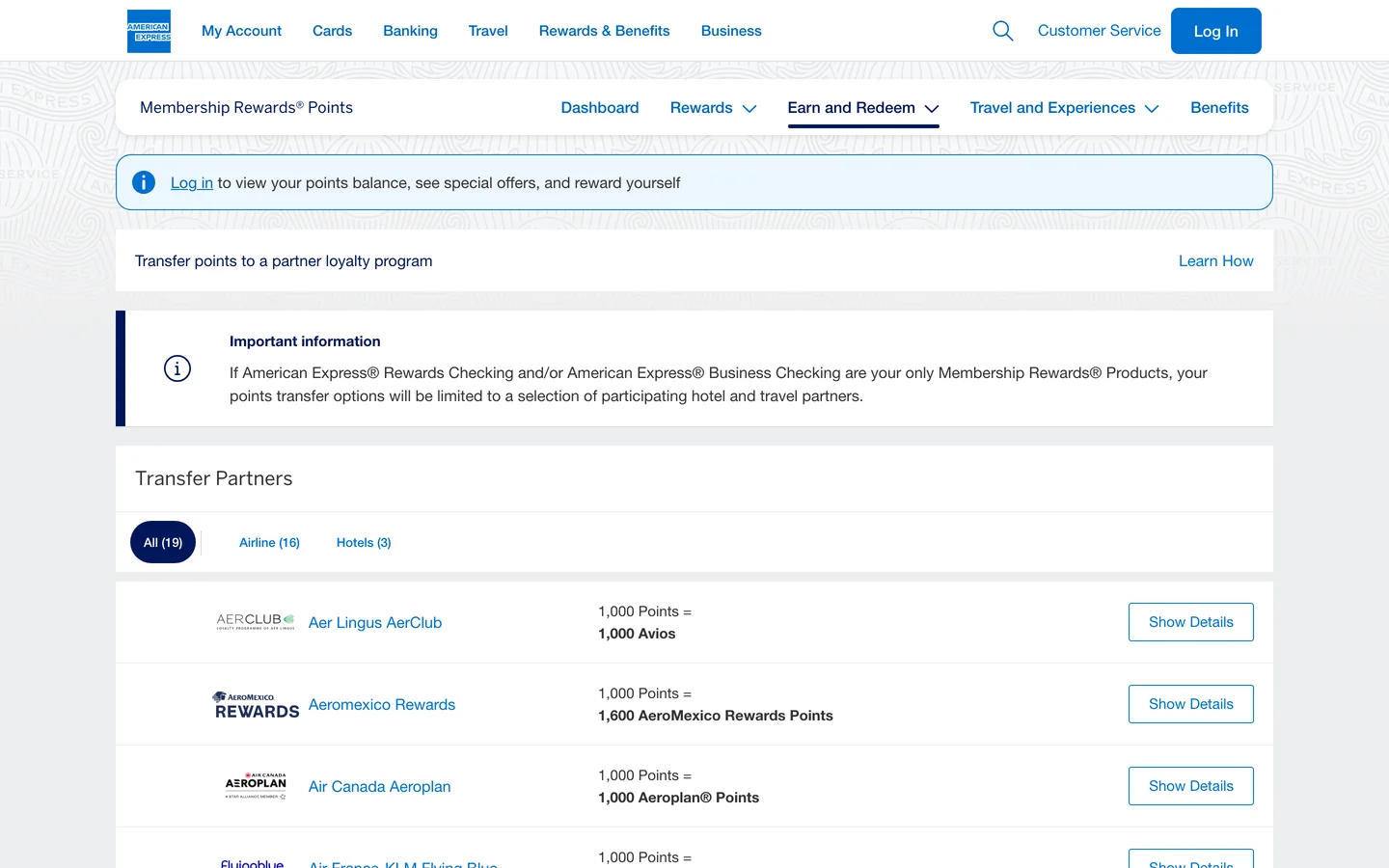
A 1:1 ratio is the baseline that makes a transferable currency worth having: there is no penalty for moving points in, so the whole calculation comes down to whether the partner can book something worth more than the cash value of the points. Two things break that clean picture in the Amex program. The good break is Aeromexico Rewards, reported at 1:1.6 — a genuinely above-parity rate that turns 1,000 points into 1,600 miles, which is rare and worth flagging as a positive. The bad breaks are the three below-1:1 partners, covered next.
The 2025-2026 devaluations and the dropped partners
The honest part of any Amex transfer map is what has been cut, because several changes in the last year quietly lowered what points are worth.
Cathay Pacific Asia Miles dropped from 1:1 to a reported 5:4 on March 1, 2026 — meaning 1,000 Amex points now yield roughly 800 Asia Miles. Emirates Skywards made the same move earlier, from 1:1 to a reported 5:4 on September 16, 2025. Both were once clean 1:1 transfers, so anyone who remembers them at par should recalibrate. JetBlue TrueBlue rounds out the below-1:1 group at a reported 250:200 ratio — effectively 1:0.8 — so it is the weakest airline conversion in the lineup on ratio alone, before the airline fee below is even counted.
Both were once clean 1:1 transfers, so anyone who remembers them at par should recalibrate.
Two partners are gone entirely. Etihad Guest was removed from the program around June 30, 2026, so as of July 2026 it should be treated as no longer available — a recently-removed partner, not a current option. And Hawaiian Airlines is no longer an Amex transfer partner either: Amex ended that partnership on June 30, 2025, tied to the Alaska/Hawaiian merger.
That Hawaiian change comes with an important correction. The combined post-merger program is now Alaska's Atmos Rewards — rebranded from Mileage Plan in 2026 — and there is no direct Amex-to-Atmos or Amex-to-Alaska transfer as of July 2026. Anyone who wants Atmos or Alaska miles funded from Amex has to route indirectly. One example is transferring to British Airways Avios, which can then be used within the shared Avios and Alaska ecosystem. But there is no one-step path from Membership Rewards into Atmos, and it should never be described as if there were.
The excise-tax fee nobody warns you about
This is the catch that most distinguishes Amex from its rivals, and it is confirmed in Amex's own program terms rather than a community estimate.
When you transfer Membership Rewards points to a U.S. airline program, Amex charges an excise-tax offset fee of $0.0006 per point, capped at $99. The fee exists to offset a federal excise tax on the value of transferred miles, and Amex passes it through at the point of transfer. As of July 2026, the only U.S. carriers in the Amex lineup are Delta SkyMiles and JetBlue TrueBlue, so those are the two transfers that trigger it. Foreign-carrier and hotel transfers do not.
The math is simple and worth doing before you move points. At $0.0006 per point, moving 50,000 points to Delta costs $30; the fee keeps scaling with the transfer until it hits the $99 ceiling, after which larger transfers cost no more. It is not a huge sum, but it is real, it is unique to Amex among the big transferable-points issuers, and it makes the already-weak JetBlue conversion (1:0.8 on ratio) look worse still once the per-point fee is added on top.
The mechanics that make or break a transfer
The map is only half the story. How the transfer itself works — all issuer-confirmed in Amex's Membership Rewards terms as of July 2026 — is what separates a good redemption from a costly mistake.
The minimum transfer is 1,000 points, in multiples of 1,000. Very small balances cannot be moved on their own, and you transfer in whole increments of a thousand.
Transfers are one-way and final. Once points leave Membership Rewards for a partner, they cannot be moved back — not to Amex, and not to a different partner. This is the single most important rule, and it is why award space should always be confirmed before points move.
Once points leave Membership Rewards for a partner, they cannot be moved back — not to Amex, and not to a different partner.
They are not instant. Amex states that transfers typically take 48 hours, and some programs delay posting further. Some partners do post faster, but the safe assumption is the stated window, not immediacy — especially when a specific award seat is on the line and could vanish before the miles arrive.
Because a transfer is irreversible and not instant, the disciplined order of operations is always the same: find the award, confirm the space is bookable, and only then transfer the exact number of points needed. Working backward from a confirmed seat — rather than speculatively front-loading a partner account — is the habit that protects value.
Which partners are actually worth using
All the partners transfer points, but they are not equally useful. The durable reasons certain partners get cited as high value come down to how their award rules are built — not any specific award price, which changes constantly and should always be checked live.
- ANA Mileage Club has historically been strong for round-trip premium-cabin awards on Star Alliance carriers, which is a big part of why the ANA transfer is prized among Amex holders.
- Virgin Atlantic Flying Club is valued less for Virgin's own flights than as a tool to book partner airlines through its program, which can open up itineraries priced attractively under Virgin's award rules.
- Air Canada Aeroplan stands out for its stopover flexibility and broad Star Alliance reach, letting a single award ticket cover complex routings across a large network.
- British Airways Club, Iberia Plus, and Qatar Airways Privilege Club (all Avios) use distance-based award pricing, which rewards short nonstop hops — the shorter the flight, the fewer Avios it tends to take, making them efficient for regional trips.
- Air France/KLM Flying Blue is a strong option for travel to and within Europe, and it runs monthly discounted Promo Rewards that periodically lower the miles needed on rotating routes.
On the hotel side, Hilton Honors at 1:2 looks generous because a thousand points become two thousand — but Hilton points are individually low-value, so the doubling is high-volume rather than high-value, and it rarely beats holding the points for a stronger airline transfer. The through-line is that a partner is only worth it when it can book a specific award for meaningfully more value than the points would fetch as cash — and when the seat or room actually exists. For a wider view of how these partners stack up against other currencies, see the hub on which transfer partners actually matter.
The cards that earn Membership Rewards
For completeness, Membership Rewards points are earned by a specific family of Amex products. As of July 2026 that family includes The Platinum Card, the American Express Gold Card, the Green Card, and the business cards — Business Platinum, Business Gold, and Blue Business Plus. Points earned on any of those can be pooled and transferred to the partners above. This is a factual note about how the ecosystem is structured, not a nudge toward any product.
The honest trade-offs
Pros
- A broad, mostly-1:1 airline lineup — Aeroplan, Flying Blue, ANA, Singapore, Avianca, the Avios trio and more — makes Amex points genuinely flexible rather than locked to a fixed cash value.
- Aeromexico Rewards transfers above parity at a reported 1:1.6, a rare bonus that turns 1,000 points into 1,600 miles.
- Standout sweet spots (ANA Star Alliance premium cabins, Virgin partner bookings, Aeroplan stopovers, Avios short hops, Flying Blue Promo Rewards) can deliver value well above the cash rate.
- The 1,000-point minimum is low enough to top off a partner account for a specific award.
Cons
- The excise-tax offset fee ($0.0006 per point, capped at $99) on Delta and JetBlue transfers is unique to Amex and adds real cost that rivals do not charge.
- Three partners now sit below 1:1 — Cathay Pacific Asia Miles and Emirates Skywards at 5:4, JetBlue TrueBlue at 1:0.8 — after 2025-2026 devaluations.
- Etihad Guest and Hawaiian Airlines have both been dropped, and there is no direct path into Alaska's Atmos Rewards.
- Ratios are hidden behind login and can change with little notice, so nothing here should be trusted without confirming it in the portal.
- Transfers are one-way, final, and typically take about 48 hours rather than posting instantly.
Frequently asked questions
What are the American Express Membership Rewards transfer partners in 2026?
Are all Amex transfers 1:1?
Does Amex charge a fee to transfer points to airlines?
Can you transfer Amex points to Alaska or Atmos Rewards?
How long do Amex point transfers take?
Keep reading to put this map to work: start with the hub on which transfer partners actually matter to see how Amex stacks up against other currencies, and if points are new to you, the beginner's guide to travel points covers the fundamentals first.