We independently score every service with our Experience Index. We may earn a commission if you subscribe through links on this page — it never affects our scores or picks.
Transfer partners are the reason a flexible points currency like Chase Ultimate Rewards can be worth far more than its cash-out value — but only if the transfer is done deliberately. Move points to the wrong program, or before confirming a seat exists, and the flexibility works against you, because a transfer cannot be undone. What follows is a plain map of who Chase partners with, at what ratio, and where the durable value tends to sit, drawn from Chase's own published transfer page and press releases as retrieved on 2026-07-06.
The complete partner map
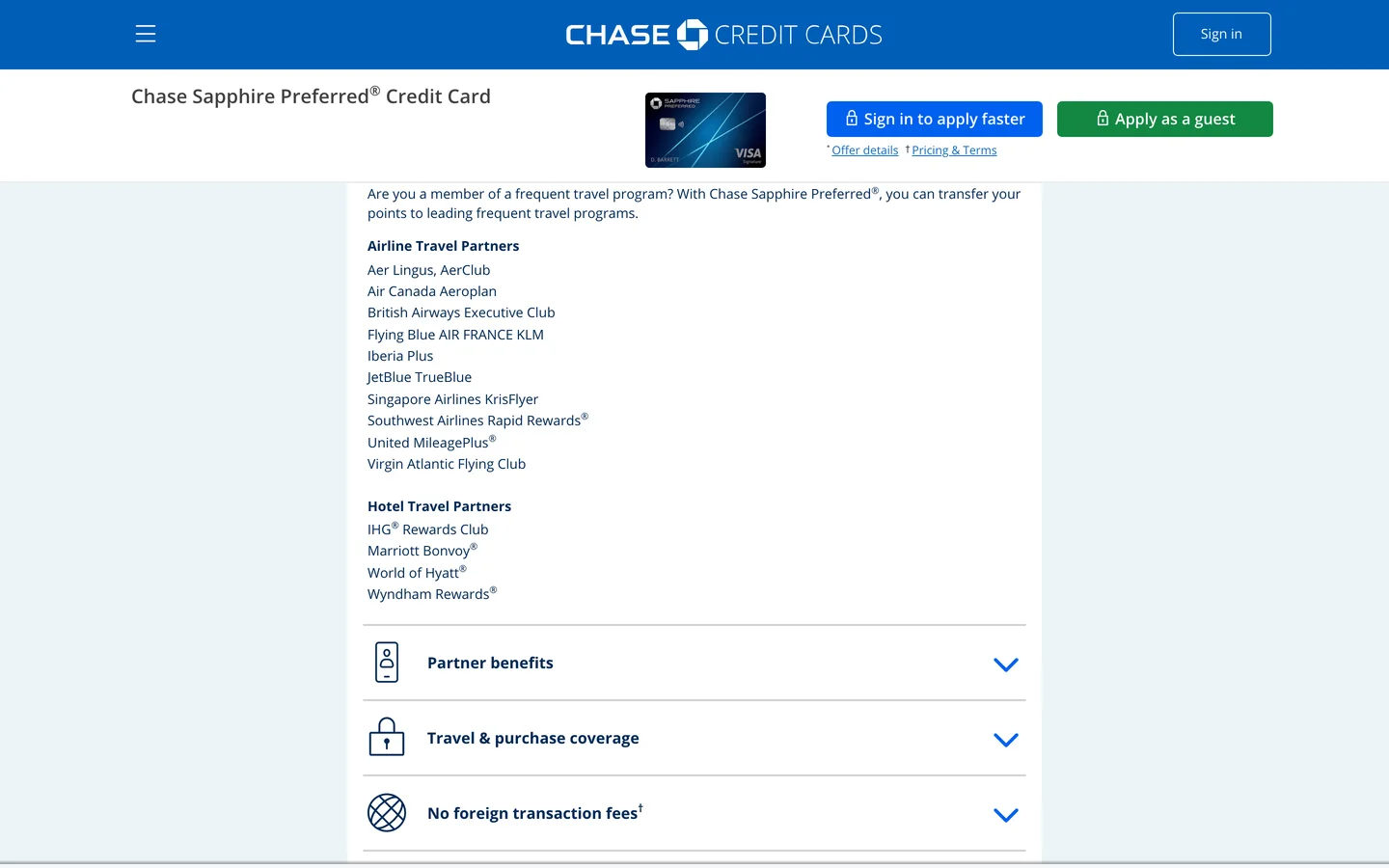
As of July 2026, Chase Ultimate Rewards has fourteen transfer partners: ten airlines and four hotels. With the single Hyatt exception below, they all transfer at 1:1, meaning 1,000 Chase points become 1,000 partner points or miles.
| Partner | Type | Ratio (Chase : partner) |
|---|---|---|
| Air Canada Aeroplan | Airline | 1:1 |
| Aer Lingus AerClub | Airline | 1:1 |
| British Airways Club (Avios) | Airline | 1:1 |
| Iberia Club (Avios) | Airline | 1:1 |
| Air France/KLM Flying Blue | Airline | 1:1 |
| JetBlue TrueBlue | Airline | 1:1 |
| Singapore Airlines KrisFlyer | Airline | 1:1 |
| Southwest Rapid Rewards | Airline | 1:1 |
| United MileagePlus | Airline | 1:1 |
| Virgin Atlantic Flying Club | Airline | 1:1 |
| World of Hyatt | Hotel | 1:1 — but moving to 4:3 on the Sapphire Preferred (see below) |
| IHG One Rewards | Hotel | 1:1 |
| Marriott Bonvoy | Hotel | 1:1 |
| Wyndham Rewards | Hotel | 1:1 |
A 1:1 ratio is the baseline that makes a transferable currency worth having: there is no penalty for moving points into a partner, so the whole calculation comes down to whether that partner can book something worth more than the cash value of the points. That is why the Hyatt change matters so much — it is the rare place where the ratio itself is about to erode.
The one 2026 change you have to know about
The single most important development for Chase points in 2026 is a Hyatt devaluation, and it is worth flagging honestly rather than burying.
As of July 2026, Chase has confirmed that World of Hyatt is moving off 1:1 for the Chase Sapphire Preferred. The new ratio is 4:3 — three Hyatt points for every four Chase points transferred. It applies to new Sapphire Preferred applicants now, and it reaches existing Sapphire Preferred cardholders on October 1, 2026. Because Hyatt is widely regarded as the highest-value hotel partner in the Chase stable, a roughly 25% haircut on the ratio is a meaningful cut for anyone who leans on it.
There are two important nuances. First, the Chase Sapphire Reserve keeps its 1:1 transfer rate to Hyatt — the change is specific to the Sapphire Preferred, so which card holds the points now changes their Hyatt value. Second, industry reports indicate the Ink Business Preferred will also move to 4:3 on October 1, 2026, but Chase has not confirmed that, so it should be treated as an industry-reported expectation rather than an issuer-confirmed fact.
The mechanics that make or break a transfer
The map is only half the story. How the transfer itself works is what separates a good redemption from a costly mistake.
The minimum transfer is 1,000 points. Chase moves points to partners in increments starting at 1,000, so very small balances cannot be transferred on their own.
Transfers are one-way and final. Once points leave Ultimate Rewards for a partner, they cannot be moved back — not to Chase, and not to a different partner. This is the single most important rule, and it is why award space should always be confirmed before points move.
They are not instant. Chase's own stated timing is that most transfers process by the next business day and can take up to seven business days. Some transfers to some partners are reported by travelers to post right away, but Chase itself only commits to the next-business-day-to-seven-days window, so it is safest to plan around that rather than assume immediacy — especially when a specific award seat is on the line.
Once points leave Ultimate Rewards for a partner, they cannot be moved back — not to Chase, and not to a different partner.
Only certain cards transfer at full value. Full 1:1 transfers require a card that earns transferable Ultimate Rewards. As of July 2026 that is the Chase Sapphire Preferred, the Chase Sapphire Reserve, and the Ink Business Preferred family. Cash-back-focused Chase cards, such as the Freedom line, earn points that must first be combined into one of those accounts before they can reach a partner. That is a factual point about how the ecosystem is structured, not a nudge toward any product.
Because a transfer is irreversible, the disciplined order of operations is always the same: find the award, confirm the space is bookable, and only then transfer the exact number of points needed. Working backward from a confirmed seat — rather than speculatively front-loading a partner account — is the habit that protects value. Our companion guide on the best ways to redeem Chase points goes deeper on that decision.
Which partners are actually worth using
All fourteen partners transfer at (or near) 1:1, but they are not equally useful. The durable reasons certain partners get cited as high value come down to how their award charts and rules are built — not any specific price, which changes constantly and should always be checked live.
- World of Hyatt is the marquee partner precisely because hotel award nights frequently deliver outsized value relative to the cash rate of the same room, particularly at higher-end properties. That is exactly why the 2026 ratio change on the Sapphire Preferred stings — and why holding Hyatt-bound points on a Sapphire Reserve, which keeps 1:1, matters more now.
- Air France/KLM Flying Blue is a strong option for travel to and within Europe, and it runs monthly discounted "Promo Rewards" that periodically lower the miles needed on rotating routes, which can make a well-timed transfer go further.
- Virgin Atlantic Flying Club is valued less for Virgin's own flights than as a tool to book partner airlines through its program, which can open up itineraries that are priced attractively under Virgin's award rules.
- Air Canada Aeroplan stands out for its stopover flexibility and broad Star Alliance access, letting a single award ticket cover complex routings across a large airline network.
- British Airways Club and Iberia Club (both Avios) use distance-based award pricing, which rewards short nonstop hops — the shorter the flight, the fewer Avios it tends to take, making them efficient for regional trips.
The through-line is that a partner is only "worth it" when it can book a specific award for meaningfully less value than the points would fetch as cash in the Chase Travel portal — and when the seat or room actually exists. Confirm award space first; the best-value target is the one that beats the portal, not the one with the most famous name. For a wider view of how these partners stack up against one another, see the hub on which transfer partners actually matter.
The honest trade-offs
Pros
- Fourteen partners at 1:1 (with the single Hyatt exception) make Chase points genuinely flexible rather than locked to a fixed cash value.
- Broad alliance reach — Aeroplan for Star Alliance, Flying Blue and the Avios programs for Europe — covers a wide range of trips.
- Standout sweet spots (Hyatt hotels, Flying Blue Promo Rewards, Virgin partner bookings, Aeroplan stopovers, Avios short hops) can deliver value well above the portal rate.
- The 1,000-point minimum is low enough to top off a partner account for a specific award.
Cons
- The Hyatt-to-Sapphire-Preferred move to 4:3 (new applicants now, existing holders October 1, 2026) devalues the most prized partner unless the points sit on a Sapphire Reserve.
- Transfers are one-way and final — a mistaken or speculative transfer cannot be undone.
- They are not reliably instant; Chase commits only to next-business-day-to-seven-days, which complicates time-sensitive bookings.
- Only Sapphire Preferred, Sapphire Reserve, and Ink Business Preferred points transfer at full value; cash-back-card points must be combined first.
Frequently asked questions
What are all the Chase Ultimate Rewards transfer partners in 2026?
Are Chase transfers to partners still 1:1?
How long do Chase point transfers take?
Which Chase cards can transfer points to partners?
Keep reading to put this map to work: start with the hub on which transfer partners actually matter to see how Chase stacks up against other currencies, then read the best ways to redeem Chase points to decide between transferring and cashing out. If points are new to you, the beginner's guide to travel points covers the fundamentals first.