We independently score every service with our Experience Index. We may earn a commission if you subscribe through links on this page — it never affects our scores or picks.
If you listen to music every day, the right streaming service can feel invisible — and the wrong one will frustrate you every time you search for something it doesn't have. This guide cuts through the noise for US listeners in 2026, covering the services worth your money and the ones worth skipping.
Why is Spotify our top pick?
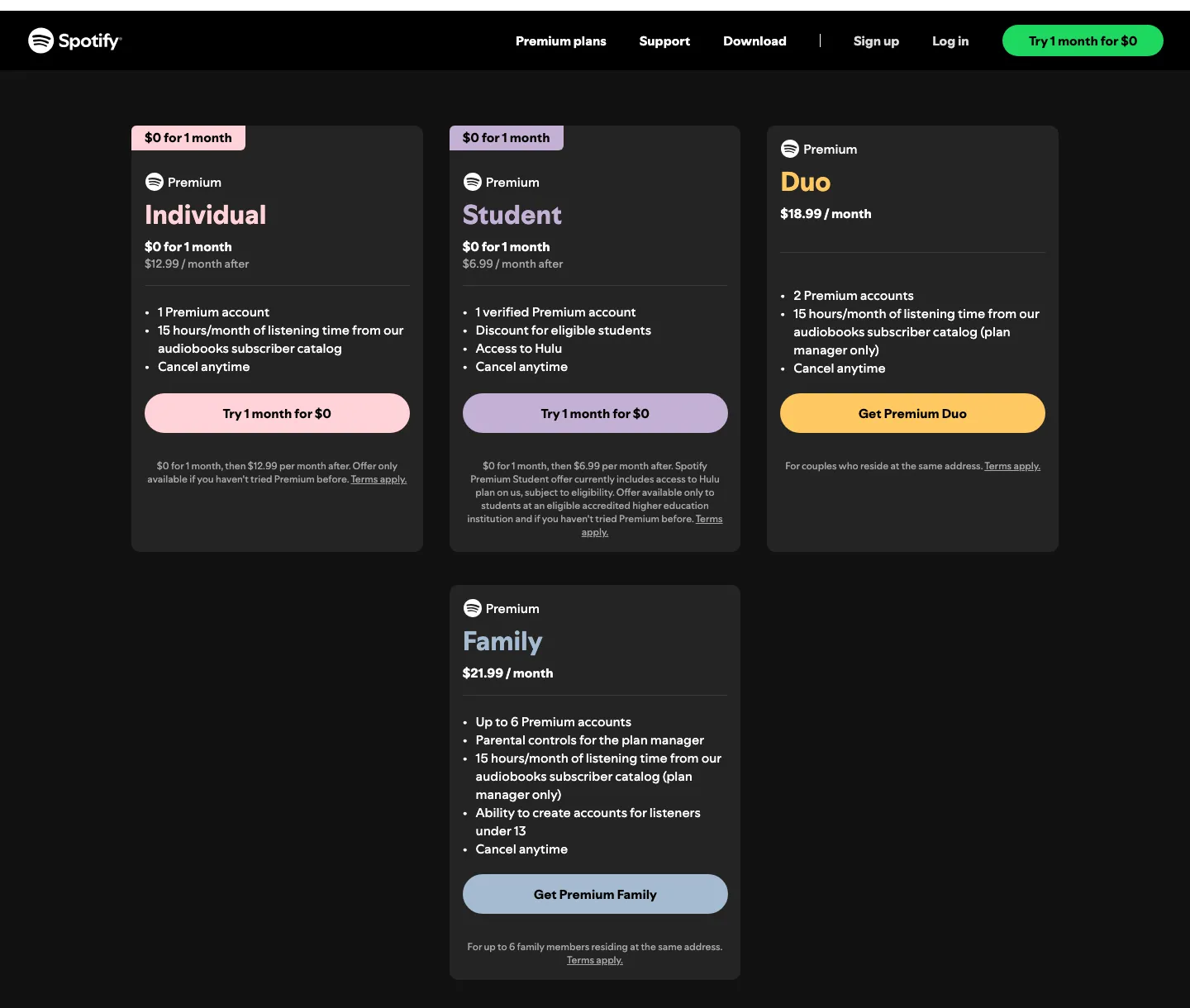
Spotify is the default recommendation for a reason: it works on every device imaginable, its recommendation engine is genuinely excellent, and it has a free ad-supported tier that lets you test-drive it without a credit card. Individual Premium runs about $12.99/month (as of June 2026), with Duo at about $18.99, Family at about $21.99, and Student at about $6.99 — pricing that lands right where most competitors do.
Try Spotify PremiumThe downside is audio quality. Spotify tops out at 320 kbps Ogg Vorbis — fine for most listeners, but it doesn't offer lossless or hi-res audio. If you own a good DAC or care about bit-perfect playback, Spotify will disappoint.
Pros
- Best-in-class discovery (Discover Weekly, Daily Mixes, AI playlist tools).
- Widest device and third-party app support of any service.
- Free ad-supported tier — no credit card required.
- Strong podcast and audiobook integration in one app.
Cons
- No lossless audio as of mid-2026.
- Free tier shuffle restrictions and ads have gotten more aggressive.
- Student and family plan verification processes can be tedious.
Should Apple users choose Apple Music?
Apple Music is actually a touch cheaper than Spotify — about $10.99/month for Individual, $16.99 for a six-person Family plan, and $5.99 for Student (as of June 2026) — and it includes lossless and hi-res lossless audio (up to 24-bit/192kHz) plus Dolby Atmos spatial audio at no extra charge. That alone puts it ahead for audiophiles who aren't ready to pay for Tidal.
The catalog is comparable to Spotify's, with over 100 million tracks. Discovery is improving but still lags behind Spotify's algorithmic recommendations. If you live in the Apple ecosystem — iPhone, Mac, HomePod, Apple Watch — integration is seamless in a way no competitor matches.
The deal-breaker for some: it's Apple-first. The Android app is adequate but noticeably less polished, and there's no web player worth relying on.
Try Apple MusicPros
- Lossless and hi-res lossless audio included at the base price.
- Dolby Atmos Music library is the deepest of any service.
- Tight integration with iPhone, AirPods, HomePod, and Apple Watch.
- Six-person family plan at a competitive price.
Cons
- No free tier (three-month trial, then you pay).
- Android and web experiences lag the native iOS/Mac apps.
- Discovery and algorithmic playlists are a step behind Spotify.
Which service is best for audiophiles?
Tidal offers hi-res lossless FLAC and a growing Dolby Atmos Music catalog. Its HiFi tier is priced in the same ballpark as Spotify and Apple Music, making the audio quality jump surprisingly accessible for listeners with good headphones or a home stereo setup.
The catalog is solid but has historically had more gaps than Spotify or Apple Music — some indie labels and certain regional music are still missing. Tidal has worked to close that gap, but you may want to check that your go-to artists are on the platform before switching.
Is YouTube Music the best-value option?
YouTube Music is easy to overlook, but if you're already a YouTube Premium subscriber, you're getting it for free. YouTube Premium runs about $15.99/month (as of June 2026) and bundles ad-free video, background play, and YouTube Music — only a few dollars more than the music-only plan, which makes it essentially the best-value way in if you want both.
Standalone, YouTube Music is about $11.99/month for Individual, $18.99 for Family, and $5.99 for Student — competitive with Spotify and Apple Music. Its killer feature is access to unofficial recordings, live sessions, and user-uploaded content that no other licensed service carries. Discovery is improving but still feels less curated than Spotify. The app has improved meaningfully over the past two years, though it still isn't the most refined experience.
How do the prices compare?
Individual plans cluster tightly, so the real differences are at the Family and Student tiers — and whether you already pay for a bundle (YouTube Premium, Amazon Prime) that softens the cost. All figures below are US monthly prices as of June 2026.
| Service | Individual | Family | Student | Lossless audio |
|---|---|---|---|---|
| Spotify | $12.99 | $21.99 (up to 6) | $6.99 | No |
| Apple Music | $10.99 | $16.99 (up to 6) | $5.99 | Included |
| YouTube Music | $11.99 | $18.99 (up to 6) | $5.99 | No |
| Amazon Music Unlimited | $11.99 (Prime) / $12.99 | $21.99 (up to 6) | $5.99 | Included |
A note on Amazon Music: it's the value play for Prime households, since the Individual plan drops to about $11.99/month for Prime members (about $12.99 without Prime, as of June 2026) and it includes lossless and spatial audio. Apple Music is the cheapest Family plan of the group, and three of the four undercut Spotify at the Student tier.
How did we evaluate these services?
We looked at four dimensions:
Catalog breadth. Does it have the music you actually want? We checked across popular, indie, classical, jazz, and international genres.
Audio quality. What's the ceiling? Lossless matters if you have the hardware to hear it; 320 kbps is fine for earbuds on a commute.
Discovery and curation. Does the service help you find new music, or does it just play what you already know?
Subscriber experience. This includes how transparent the pricing is, how easy it is to cancel, and whether prices have stayed stable. Check the Experience Index for structured data on exit ease and price stability across streaming services.
Who should skip paying for music streaming?
If you primarily listen to a small, fixed library of albums, buying digital downloads (or ripping your own CDs) may be more cost-effective long-term. You own what you buy; streaming licenses can vanish when label deals expire.
If you listen occasionally, Spotify's free tier or Apple Music's trial period are genuinely usable before you commit to monthly payments. And if a big chunk of your listening is audiobooks rather than music, a dedicated audiobook subscription may be the better spend — see whether Audible is worth it before stacking it on top of a music plan.
Try AudibleUse the subscription calculator to see what you'd spend versus what you'd save switching to a family or student plan.
So which music streaming service should you pick?
For most people, Spotify is the right starting point — best discovery, widest compatibility, and a free tier to try it risk-free. Apple users who care about sound quality should take Apple Music seriously: lossless audio at no premium is a real advantage, and it's the cheaper plan of the two. Still torn between them? Our Spotify vs. Apple Music comparison breaks down the trade-offs head to head. Dedicated audiophiles willing to confirm catalog coverage should look at Tidal. And if you're already paying for YouTube Premium, activate YouTube Music — you're leaving money on the table if you don't.
For structured data on how these services score on exit ease and price stability, check the Experience Index. Or browse all music subscription reviews for deeper dives into each service.